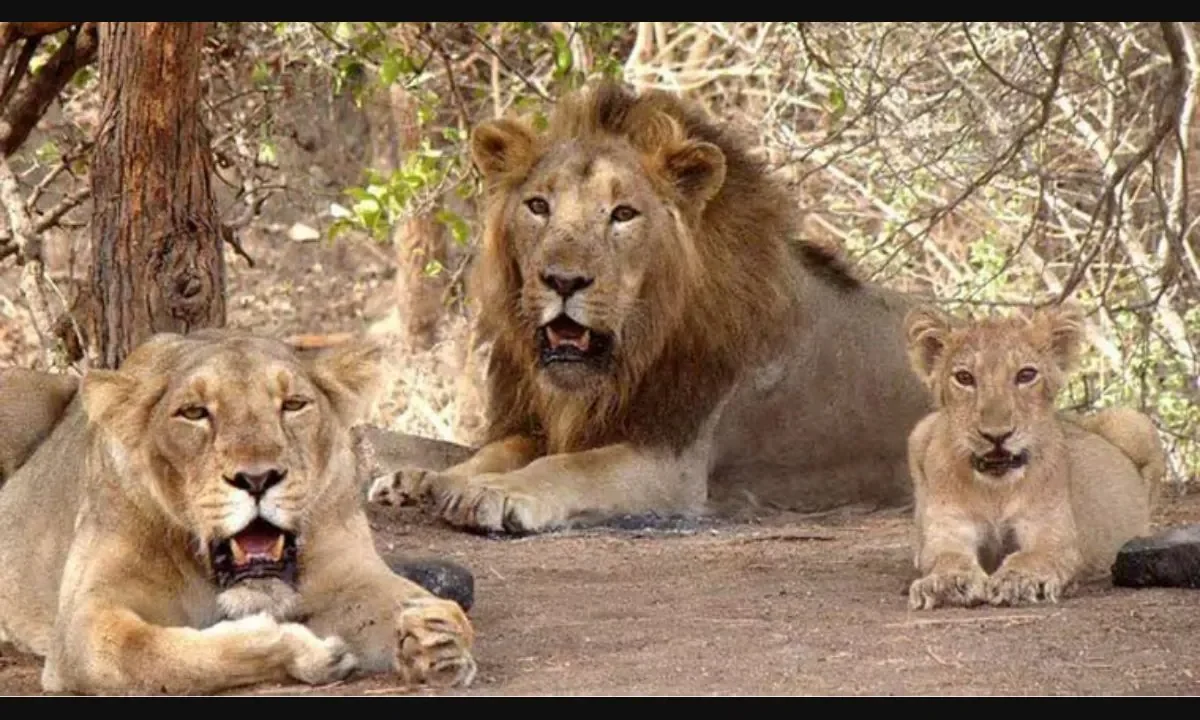

Asiatic Lions of Gir: The Case for a Secondary Habitat
Indiadailyupdate.com – The survival of Gir’s iconic Asiatic lions depends on securing an additional refuge. These magnificent predators rely on a diverse array of wild ungulates for sustenance. Their primary game includes chital (Axis axis), sambar (Rusa unicolor), nilgais (Boselaphus tragocamelus), and wild pigs (Sus scrofa). Smaller prey items such as chousingha (Tetracerus quadricornis), chinkara (Gazella bennettii), and grey langurs (Semnopithecus entellus) also feature in their diet.
Domestic animals form another crucial food source. The local Maldhari pastoral community’s buffaloes (Bubalus bubalis) and Brahminy cattle (Bos taurus) are regularly hunted. During drought conditions, substantial numbers of these livestock migrate into the Gir Protected Area for grazing. Historical records show that lions have attacked humans when water and prey become scarce.
Prey Distribution and Dietary Patterns
Outside the protected boundaries, Brahminy cattle and wild ungulates like nilgais and wild pigs dominate the lion menu. Analysis of kill sites within the reserve reveals that male chital and male sambar are particularly susceptible to predation. Wild ungulates constitute the larger portion of the lions’ diet inside the reserve, while domestic animals play a more significant role beyond its borders.
Social Structure and Coalition Dynamics
The social framework of Gir lions closely mirrors that of their African counterparts. The pride serves as the fundamental building block of this matrilocal society, comprising related females without strict hierarchy and their offspring. These prides operate as fission-fusion groups where membership remains relatively constant. Females often give birth simultaneously, and cubs are raised communally, nursing freely from any lactating female in the group.
The adult sex ratio stands at one male to two females. Since no female belongs exclusively to a single male coalition, promiscuity is common. This behavior helps prevent infanticide and strengthens genetic diversity. A coalition of up to five males, or sometimes a solitary male, controls one or more prides. The dominant male within the coalition secures the majority of mating opportunities and receives the largest portion of kills.
Optimal coalition tenure lasts approximately thirty months, providing sufficient time for cubs to mature safely away from infanticidal threats. Male lions demonstrate considerable independence, occasionally hunting wild ungulates, stealing kills from females and leopards, preying on livestock, or consuming cattle carcasses left by Maldharis and transported by Forest Department personnel.
Hunting Techniques and Behavioral Adaptations
A key distinction between Serengeti and Gir lions involves male coalition behavior. In Gir, males join female groups primarily during substantial kills or when females enter estrus. This pattern likely stems from the average weight of chital—approximately forty kilograms—which may not sustain a female group if males remain constantly present. Kin selection prevents males from stealing food from their own offspring, as such behavior would endanger cub survival.
Gir lions typically hunt after dark, employing stalking techniques common to felines. Larger prey falls victim to ventral neck bites delivered before the kill is finalized. When attacking domestic buffaloes, lions leap onto the animal’s back, secure it with their forepaws, and bite while keeping their hind legs planted firmly for leverage. One documented instance showed two lionesses killing a massive nilgai bull by biting across its muzzle—a technique Serengeti lions use against wildebeest. The nilgai’s thick, muscular neck rendered traditional neck bites ineffective, and claw marks appeared on its sides and back.
Communication and Territorial Behavior
Consumption patterns vary based on kill size and pride numbers. Unlike Kalahari lions, Gir residents rarely face water scarcity due to natural sources and designated drinking points maintained by the Forest Department.
Adult and near-adult lionesses greet each other through head rubbing. Interactions between adult males and females, excluding courtship, tend to be sharp and subordinating for the female. Vocal communication includes ‘moah’ calls for cubs, coughs and grunts signaling alarm, growls for warnings, and roars functioning as long-distance signals. Female roars are weaker and shorter than male vocalizations.
Territorial advertisement occurs through multiple methods: roaring, spraying, defecation, and tree clawing. In habitats experiencing disturbance, lions exhibit behavioral patterns reminiscent of tigers.
Related Reading
Frequently Asked Questions
What is Why Gir s endangered Asiatic lions?
Why Gir s endangered Asiatic lions is the main topic of this guide. The article explains the context, practical details, and next steps readers should understand.
Why does Why Gir s endangered Asiatic lions matter?
Why Gir s endangered Asiatic lions matters because readers are looking for a useful answer, not just a short summary. Good content should match search intent and help them decide what to do next.