
From Shipboard Waiter to ₹8,000 Crore Cruise Empire: The Austrian Behind India’s Maritime Tourism Monopoly
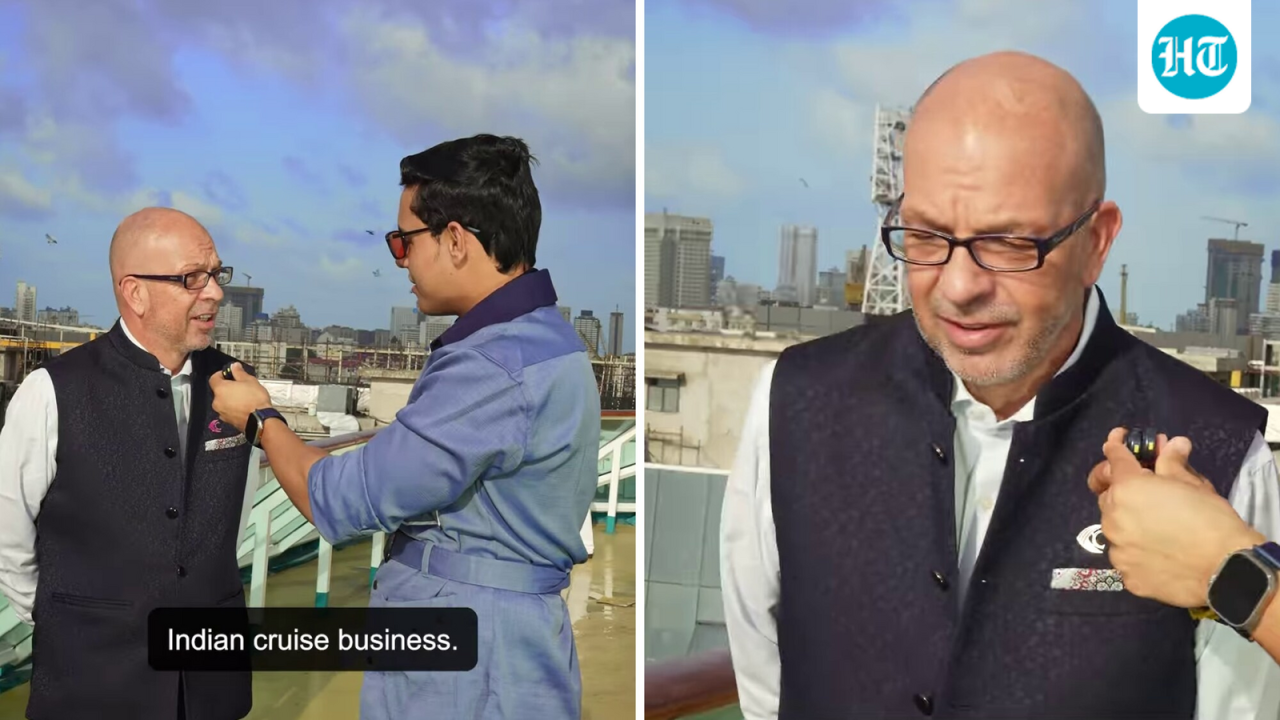
Indiadailyupdate.com – On the sun-blasted upper deck of a sprawling luxury liner, content creator Navan Jaiswal approached a man who would go on to dominate an entire industry. That man was Jurgen Bailom, an Austrian national who, after four decades in hospitality, now commands a cruise operation valued at roughly ₹8,000 crore and controls an estimated 99 percent of India’s domestic cruise market. The arc of his professional life — from serving meals to passengers on a commercial vessel to steering one of South Asia’s largest maritime tourism enterprises — reads like a narrative no business school case study would predict.
A Career Built from the Bottom Deck Up
Bailom’s entry into the hospitality world was unglamorous by any measure. His first role was as a waiter aboard a ship, a position that placed him at the lowest rung of a rigidly hierarchical industry. Over the following four decades, he climbed through every tier of the sector, attributing his upward mobility to two qualities: relentless work ethic and a capacity to adapt to unfamiliar environments and cultures.
When pressed on what enabled his ascent, he offered a characteristically blunt answer:
“The ‘can-do’ attitude. I learned very quickly, and understand the markets, the people, the culture.”
That adaptability would prove decisive when he turned his attention to India, a market whose scale and coastline presented opportunities no European or Southeast Asian cruise operator had fully exploited.
The Scale of Cordelia Cruises
Waterways Leisure Tourism Limited, the corporate entity Bailom leads, operates the Cordelia Cruises brand. The operation’s valuation sits close to ₹8,000 crore, a figure that places it among the most valuable private tourism assets in the country. With a single vessel currently in active service, the enterprise generates annual revenue in the range of ₹600 to ₹700 crore — a number that underscores how concentrated and lucrative the Indian cruise segment remains.
The 99 percent market-share figure Bailom cites is not merely a marketing claim; it reflects the fact that India’s domestic cruise infrastructure, port facilities, and regulatory framework have, until very recently, supported only a handful of operators. Cordelia Cruises effectively defines the category for most Indian passengers who have ever boarded a cruise ship from a domestic port.
Why India, Why Now
Bailom relocated to India in 2018, a decision driven by what he perceives as an under-tapped geographic advantage. India possesses the third-longest coastline in the world, stretching over roughly 7,500 kilometres along the Arabian Sea, Bay of Bengal, and Indian Ocean. For a cruise operator, that expanse translates into dozens of potential embarkation points, seasonal itineraries, and a domestic passenger base that has historically been locked out of maritime tourism by cost and availability.
“India is a very beautiful country. To have a cruise business is a no-brainer in India. You have the third-largest coastline,”
He explained. The logic is straightforward: a coastline of that magnitude, combined with a middle-class population of over 500 million and a government that has begun investing in port modernisation and coastal tourism zones, creates conditions for sustained demand growth that no mature Western market can match in percentage terms.
Adapting to Indian Business Culture
Operating a multinational hospitality brand from Mumbai required more than financial acumen. Bailom has spoken openly about adjusting to local customs, including the cultural weight Indians place on auspiciousness and ritual. In a 2019 interview with Mint, he described incorporating pujas into his office routine and even repositioning furniture to align with traditional directional preferences.
“We regularly have pujas in the office and ensure we are doing well financially. I have even rearranged my office and made sure the desks are pointing in the right direction.”
That willingness to embed himself in local practice — rather than imposing a purely Western corporate template — has been a recurring theme in his public remarks. He has also commented on the pace of life in Mumbai, describing a city where commerce never pauses:
“Everyone works hard in Mumbai and no one ever sleeps. Everyone is hustling, trying to sell something and doing their very best to make a living.”
A Philosophy of Money and Restraint
Bailom’s personal financial philosophy, shared during his conversation with Jaiswal, runs counter to the conspicuous-consumption narrative often associated with high-earning executives. His advice to those building wealth is deceptively simple:
“Don’t spend it if you don’t have to. I am a very strong believer: you don’t have to run after money, money is running after you if you know what to do.”
The statement encapsulates a broader operational principle visible in Cordelia Cruises’ growth strategy: rather than chasing volume through aggressive pricing, the company has focused on deepening service quality, expanding itinerary variety, and cultivating a loyal domestic clientele — a patient, compounding model that mirrors the long-cycle economics of shipbuilding and fleet management.
What Comes Next
As India’s coastal infrastructure matures and government incentives for domestic tourism strengthen, the cruise segment is expected to attract additional entrants. For Bailom, the competitive question is no longer whether the market exists but whether his operational model — built over forty years of shipboard discipline, cultural fluency, and what he calls a “can-do” orientation — can scale beyond a single vessel without diluting the service standard that underpins his near-total market position. The answer, for now, remains written in the ledger of a ₹8,000 crore enterprise that began, improbably, with a waiter’s tray on a foreign sea.
Related Reading
Frequently Asked Questions
What is The Austrian CEO who runs a 8?
The Austrian CEO who runs a 8 is the main topic of this guide. The article explains the context, practical details, and next steps readers should understand.
Why does The Austrian CEO who runs a 8 matter?
The Austrian CEO who runs a 8 matters because readers are looking for a useful answer, not just a short summary. Good content should match search intent and help them decide what to do next.