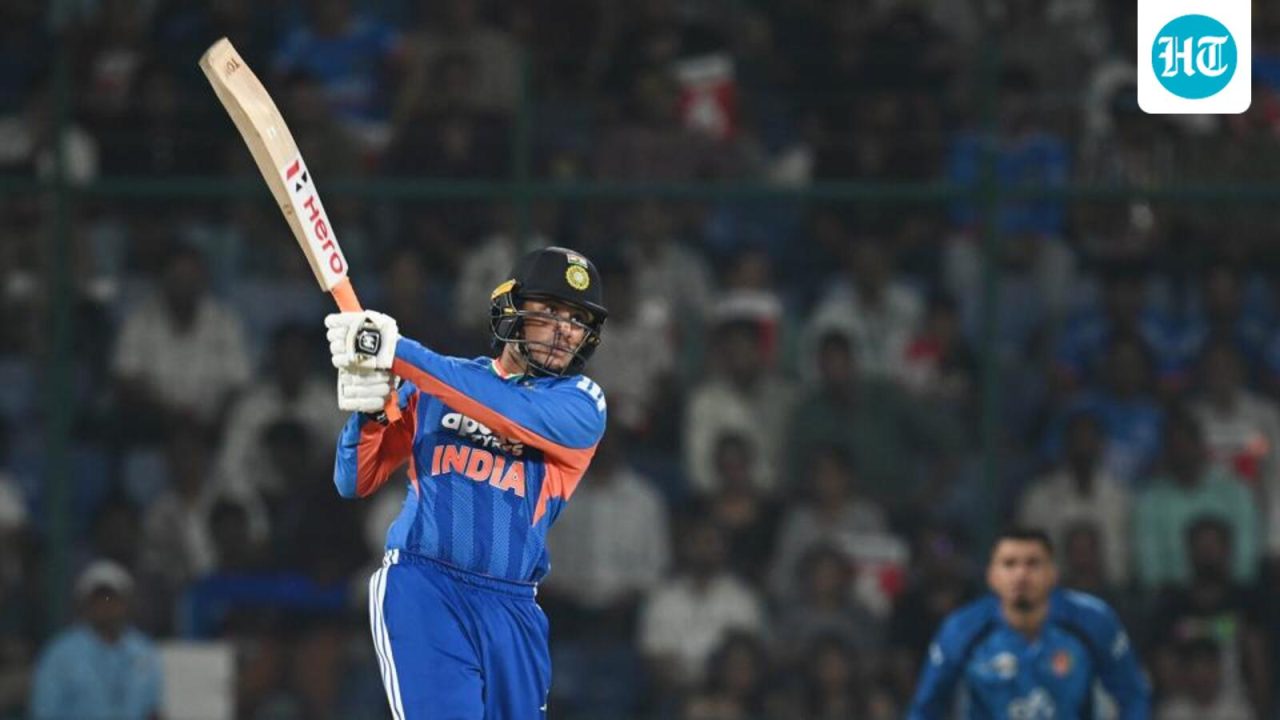

Abhishek Sharma’s blazing hundred powers India to emphatic series sweep
Indiadailyupdate.com – India completed a 3-0 T20I series clean sweep over Afghanistan with a commanding 127-run victory, driven by a breathtaking innings from Abhishek Sharma. The left-handed opener struck 108 at extraordinary pace, registering the quickest men’s T20I century by a player from a Test-playing nation and setting the tone for a one-sided finish.
After reaching his landmark, Abhishek marked the occasion by sitting cross-legged in a calm, meditative celebration. The gesture resembled footballer Erling Haaland’s familiar “zen” pose, though there had been nothing calm about the assault that came before it. Afghanistan’s bowlers had been put under relentless pressure from the opening overs as India surged to 221/7.
A PowerPlay dominated by Abhishek
India’s opening burst effectively decided the contest. The hosts collected 100 runs during the PowerPlay, with Abhishek racing along at a strike rate above 340. His intent was clear almost immediately, and after only eight deliveries, the possibility of another major score was already apparent.
He reached fifty from 17 balls in the fourth over, the sixth time he has completed a T20I half-century in fewer than 20 deliveries. The Punjab batter has repeatedly come close to the mark set by his mentor Yuvraj Singh for the fastest T20I fifty. He challenged it against England in Mumbai last year and fell one ball short against New Zealand in Guwahati earlier this year.
Against Afghanistan, however, the half-century was only the first stage of an even bigger effort. Abhishek moved beyond Rohit Sharma’s previous 35-ball benchmark to claim the record for the fastest hundred in men’s T20 internationals by a batter representing a Test-playing country.
By the end of the PowerPlay, he had smashed 76 from 22 balls. Sanju Samson, though hardly slow, had 24 off 14 at that stage and was able to watch the innings unfold from the non-striker’s end. In their massive 142-run opening stand, Abhishek alone supplied 108 runs.
Nabi targeted as India seize control
Afghanistan persisted with Mohammad Nabi in the PowerPlay despite the off-spinner proving expensive in the first two games of the series. His fifth over went for 29, as Abhishek and Samson plundered four sixes and a boundary.
Rashid Khan eventually ended Abhishek’s remarkable knock. The opener attempted to lift a googly over extra cover in the leg-spinner’s second over, but the ball took an outside edge and Rahmanullah Gurbaz completed the catch behind the wicket.
Samson then carried on India’s charge, reaching his fifty from 34 balls. The middle order could not replicate the same fluency, with Shreyas Iyer making 29 off 20 deliveries. Afghanistan recovered some control late in the innings, restricting India to 221/7 after the platform created by the openers.
Rashid returned figures of 1/43, while Abdullah Ahmadzai took 1/38 and Fazalhaq Farooqi conceded 39 without a wicket. Their efforts helped limit India’s boundary count in the final four overs, when only two boundaries were struck. Given the start India had made, the late restraint offered Afghanistan some measure of recovery, but the target remained formidable.
Afghanistan’s chase collapses early
A required total of 222 was always likely to demand an exceptional batting display, but Afghanistan again found themselves unable to establish momentum at the top. Gurbaz scored 15 and finally got off the mark in the series, yet the top order did not build a foundation.
Captain Ibrahim Zadran was Afghanistan’s highest scorer with 25 from 16 balls, while Azmatullah Omarzai contributed 17. No batter was able to turn a start into the sustained innings needed to put India under pressure.
Axar Patel removed Gurbaz and Sediqullah Atal, returning outstanding figures of 2/9 and ensuring that Afghanistan never settled into the chase. Nitish Kumar Reddy then delivered the decisive passage, taking three wickets in a single over. Mohammad Nabi fell for 8, Omarzai departed for 17 and Mujeeb Ur Rehman was dismissed without scoring.
Ravi Bishnoi claimed the final wicket as Afghanistan were bowled out for 94 in 14.1 overs. Bishnoi finished with 3/26, while Nitish’s destructive spell was recorded as 3/20 in the match account, underlining India’s command with the ball after their explosive work at the crease.
A statement performance in the final match
The margin of victory reflected the gulf created during Abhishek’s innings. India’s 221/7 was built around his 108 and Samson’s 50, while Omarzai was Afghanistan’s leading wicket-taker with 2/27. Afghanistan’s reply never recovered after early wickets, ending at 94 as India sealed the match by 127 runs.
For India, the result brought together a dominant top-order display and a disciplined bowling performance. Abhishek’s record-breaking acceleration transformed the final match into a showcase of attacking T20 batting, while the bowlers ensured that Afghanistan had no opportunity to mount a response.
Brief scores: India 221/7, with Abhishek Sharma scoring 108 and Sanju Samson making 50; Afghanistan 94 in 14.1 overs, with Ibrahim Zadran scoring 25 and Azmatullah Omarzai 17. India won by 127 runs.
Related Reading
Frequently Asked Questions
What is Abhishek s zen mode destroys Afghanistan?
Abhishek s zen mode destroys Afghanistan is the main topic of this guide. The article explains the context, practical details, and next steps readers should understand.
Why does Abhishek s zen mode destroys Afghanistan matter?
Abhishek s zen mode destroys Afghanistan matters because readers are looking for a useful answer, not just a short summary. Good content should match search intent and help them decide what to do next.