Jogen Chowdhury’s Legacy Reaches Far Beyond His Signature Figures
Indiadailyupdate.com – Indian art has lost a defining modern voice with the death of Jogen Chowdhury at the age of 87. Celebrated for his finely worked, psychologically charged figures, Chowdhury left behind a legacy that extended well beyond the studio: he was a teacher, institution-builder, curator, arts administrator and public representative.
He had been receiving cancer treatment for two years and was recently admitted to hospital with a urinary tract infection. He was placed on ventilator support on Saturday and died on Sunday. He is survived by his wife, Shipra, and their son, Soumya.
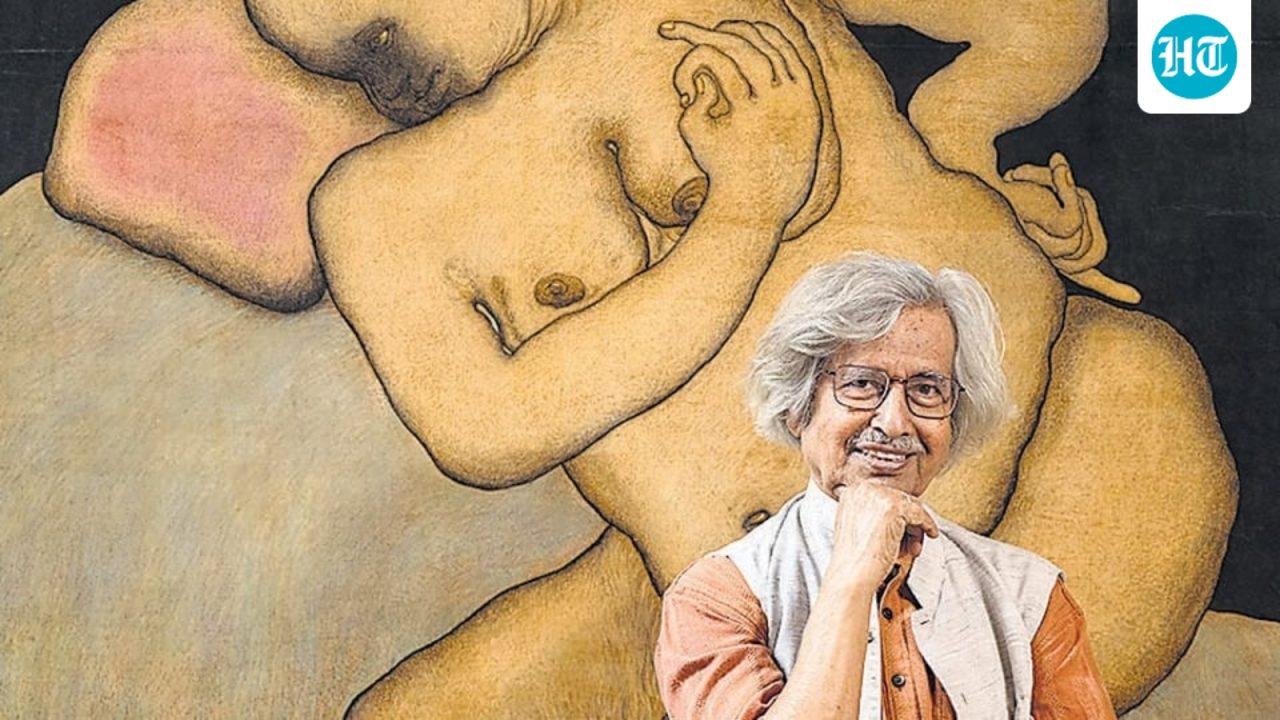
For generations of artists and viewers, Chowdhury’s paintings offered an unmistakable visual language. His distorted human forms, marked by continuous, vein-like lines and dense crosshatching, could appear intimate, satirical, tender and unsettling at the same time. Yet reducing his work to that celebrated style overlooks the range of his practice and the breadth of his engagement with India’s cultural life.
An Artist of Many Mediums and Moods
Chowdhury worked across drawing, watercolour, lithography and painting. Crosshatching, created through intersecting lines that generate texture and shadow, became one of his most recognisable techniques. In his hands, it gave bodies an almost restless energy, bringing inner tension to the surface.
Works from his Dream series, including Reminiscences of A Dream (42), Tiger in the Moonlit Night and The Couple, remain among the paintings most closely associated with him. But his artistic evolution was not confined to one visual approach.
Art historian and critic R. Siva Kumar, who worked alongside Chowdhury at Santiniketan, described an artist whose changing phases reflected different relationships with the world around him.
“Jogen was one of the pre-eminent artists of his generation, who had a very interesting personal language. On the surface, it seemed quite simple, but it also allowed him to say many things in many registers. He had many phases in his work, each offered something different.”
Kumar noted that Chowdhury’s early work responded strongly to the social conditions of his time. His later practice became more inward-looking. After moving to Delhi to serve at Rashtrapati Bhavan, he made portraits shaped by an unusually close view of political life. His years teaching at Santiniketan brought another shift, with paintings that quietly examined Bengal, India and the middle-class world he knew personally.
A Teacher Who Made an Impression
Chowdhury’s influence was equally deep in the classroom. At Kala Bhavan in Santiniketan, he served first as reader and later as principal. For many students, his teaching demonstrated that artistic power did not depend on spectacle or scale; a line, carefully observed and patiently drawn, could carry emotion, irony and ambiguity.
Ushmita Sahu, director and head curator of Kolkata’s Emami Art, studied under him at Santiniketan in 1996. She remembered both his artistic rigor and the wider perspective he brought to discussions around art.
“Beyond his extraordinary practice, he thought deeply about the larger ecosystem of Indian art: its forums, journals, institutions, and the generations still to come. Indian art has lost one of its most significant voices.”
Recalling her student years, Sahu said Chowdhury’s presence at Kala Bhavan stayed with many who encountered him there.
“As an artist, he showed us that a single line could hold the whole weight of a life, with its tenderness, irony and quiet unease.”
That ability to combine formal discipline with emotional complexity became central to his reputation. His figures may be visually strange or exaggerated, but their unease often feels recognisable: a gesture, a glance or a compressed body can suggest the pressures of private and public life.
Building Space for Art and Artists
His commitment to the visual arts also took institutional form. In 2019, Chowdhury opened Charubasona, also known as the Jogen Chowdhury Centre for Arts, in a five-storey building opposite Kolkata’s South City Mall. Conceived as a dedicated arts space, it made room for exhibitions, conversations and emerging practitioners.
One floor was set aside for seminars, another presented Chowdhury’s own work, while the ground floor was intended for younger artists. The project reflected his belief that an art world depends not only on established names but also on spaces where new voices can be seen and discussed.
Somak Mitra, founder of Kolkata gallery Art Exposure, described Chowdhury as both companion and guide. Mitra’s gallery helped organise three retrospectives of the artist’s work in Delhi, Mumbai and Kolkata.
“He was not only a friend, but also a mentor.”
Even during his final period of illness, Chowdhury continued to make art. Mitra recalled that he created small postcard sketches and gave them to doctors and nurses caring for him. The gesture echoed the generosity often associated with him by colleagues, students and collaborators.
A Public Life Rooted in Culture
Chowdhury held a number of significant roles outside his own practice. He served as Keeper of Art at Rashtrapati Bhavan and was a member of the advisory committee of the National Gallery of Modern Art in Delhi. He also worked as an exhibition curator, sat on biennale juries and illustrated a book of poetry.
In 2014, he entered the Rajya Sabha after being nominated by the Trinamool Congress. His public role added another dimension to a life already shaped by art education, cultural institutions and sustained studio work.
His engagement with displacement and social memory was visible early in his career. Sunaina Anand, founder of New Delhi’s Art Alive gallery, has recalled a drawing Chowdhury made in 1958 while still in school. It depicted migrants sitting in a railway station. When he gave the work for a Covid-19 fundraiser in 2020, he linked it to the continuing arrival of Bengali Hindu refugees from the eastern part of Bengal in the years after Partition.
A major retrospective of Chowdhury’s work was also being planned by the Kiran Nadar Museum of Art in Delhi for February 2027. Such exhibitions will offer an opportunity to revisit not merely the familiar distorted figures, but the full expanse of an artist who shaped Indian art through images, ideas, teaching and institutions.
Related Reading
Frequently Asked Questions
What is Beyond the distorted figures?
Beyond the distorted figures is the main topic of this guide. The article explains the context, practical details, and next steps readers should understand.
Why does Beyond the distorted figures matter?
Beyond the distorted figures matters because readers are looking for a useful answer, not just a short summary. Good content should match search intent and help them decide what to do next.