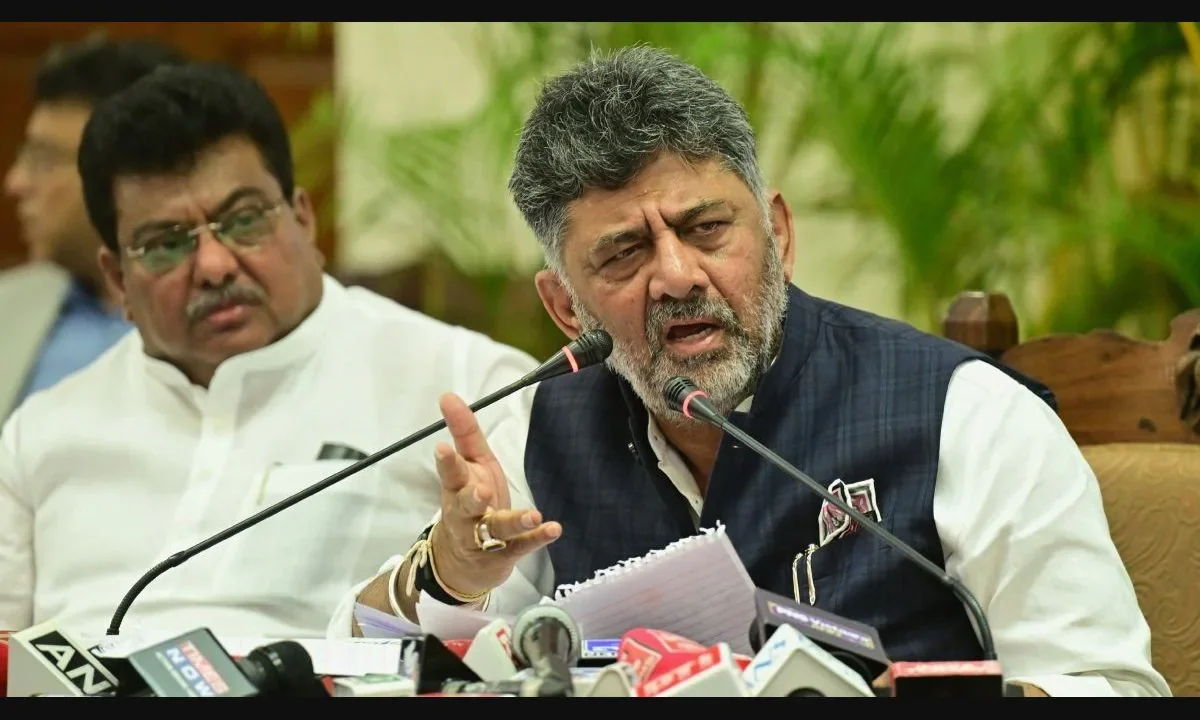

Bidadi Township Row: Shivakumar Accuses JD(S) of Hypocrisy
Indiadailyupdate.com – The ongoing Bidadi township row has intensified as Karnataka’s Chief Minister, D.K. Shivakumar, defended the project against accusations of political maneuvering. During a press conference at Vidhana Soudha, Shivakumar addressed criticisms from former Prime Minister H.D. Deve Gowda, who had previously condemned the initiative. He clarified that the Bidadi township development was not a personal undertaking but a continuation of earlier efforts, highlighting its roots in the JD(S)-BJP alliance under H.D. Kumaraswamy and its subsequent progress under the B.S. Yediyurappa government. The debate centers on land allocation, developer involvement, and the role of political leadership in shaping the project’s trajectory.
Historical Context and Government Continuity
The Bidadi township row has sparked renewed discussions about the project’s origins and evolution. Shivakumar emphasized that the idea for satellite towns around Bengaluru was first proposed in 2006 during the JD(S)-BJP coalition, with the Karnataka government designating the area as a “red zone” for eviction processes. A Gazette notification from November 29, 2006, marked this initial step, which was later expanded to include Mandalahalli and Vaderahalli villages in 2007. The Yediyurappa administration revived the plan in 2010, under the leadership of R. Ashoka, demonstrating the project’s long-standing political and administrative support.
“This initiative has been a collaborative effort across multiple governments, and I have scrutinized every aspect of the criticism Deve Gowda has made,” Shivakumar stated, underscoring the project’s bipartisan legacy.
Accusations of Hypocrisy and Land Deals
Shivakumar accused the JD(S) leadership of inconsistency, pointing to past decisions that allegedly aligned with the township’s development. He highlighted that leaders had not raised objections during earlier phases of the project, despite their current stance. The chief minister also alleged that the opposition was leveraging the Bidadi township row to tarnish his reputation, suggesting a coordinated effort to discredit him. “Did I orchestrate this? Or were others pushing for land acquisition all along?” he questioned, challenging the narrative of the project being a personal agenda.
Shivakumar’s claims revolve around land ownership and compensation. He revealed that some members of Deve Gowda’s family held land in the township area, implying a potential conflict of interest. The Bidadi township row has become a focal point for debates about transparency, with Shivakumar arguing that the project’s progress was driven by collective goals rather than individual gain.
Developer Involvement and Compensation Framework
The Bidadi township row has also drawn attention to the role of private developers. Shivakumar noted that DLF, a prominent real estate firm, joined the project after investing ₹400 crore, with land compensation fixed at ₹25 lakh per acre. He emphasized that the government had not forced land acquisitions but had instead engaged in negotiations with local stakeholders. “The compensation was determined through a transparent process, and the landowners were given fair options,” he stated, defending the project’s implementation.
Shivakumar’s focus on developer participation reflects a broader effort to frame the Bidadi township row as a result of long-term planning. By linking the project to the Yediyurappa government’s public-private partnership model, he aimed to distance himself from allegations of self-interest. However, the controversy persists, with critics arguing that the government’s previous inaction on land issues now fuels accusations of hypocrisy.
Community Impact and Political Strategy
The Bidadi township row has raised concerns about its impact on local communities. Shivakumar assured farmers that the government would not resort to coercive methods in acquiring land, pledging to form a committee to address all grievances. “Women in the Bengaluru Urban district are particularly vulnerable to misinformation, and we must ensure their voices are heard,” he added, acknowledging the social dimensions of the dispute.
Meanwhile, the opposition’s criticism has taken on a strategic tone. Deve Gowda’s public condemnation of the project is seen as part of a larger effort to challenge the current government’s policies. Shivakumar’s rebuttal, framed around the Bidadi township row, underscores his determination to protect the project’s credibility. “This is not just about land—it’s about the integrity of our governance,” he asserted, aligning the dispute with broader political themes.
Public Perception and Future Steps
As the Bidadi township row gains traction, public perception remains divided. Supporters argue that the project will alleviate urban congestion and provide economic opportunities, while critics accuse the government of prioritizing political alliances over community welfare. Shivakumar has called for a transparent review process, urging all parties to engage in dialogue. “The Bidadi township row is a test of our commitment to equitable development,” he said, framing the controversy as a necessary step in refining the project’s implementation.