Anupam Sud Retrospective Traces Delhi’s Printmaking Past
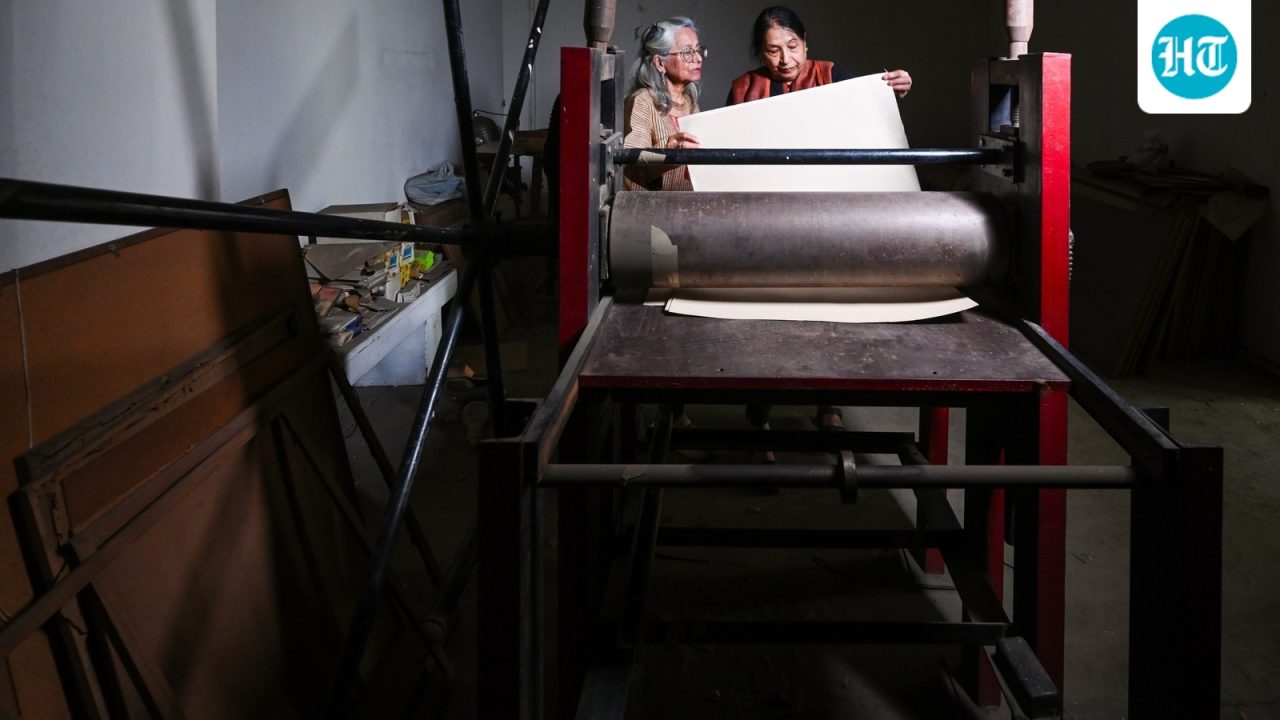
Indiadailyupdate.com – A printing press stands at the centre of a shadowed room in the long-closed premises of Delhi Silpi Chakra, its surface surrounded by dust and the accumulated quiet of years. Once sunlight enters through a forced-open balcony door, the machine becomes visible again: a locally built press designed by artist and teacher Jagmohan Chopra, and formerly used by printmaker Anupam Sud.
The press is more than an old piece of equipment. It recalls a period when Delhi’s artists worked to build practical spaces for printmaking, a discipline dependent on specialised materials, heavy machinery and sustained collective effort. At 82, Sud remains closely linked with that history, having helped shape the city’s artistic life through decades of work in print, painting, drawing and watercolour.
From October 23, the National Gallery of Modern Art will host a major retrospective of Sud’s work. Presented by Dhoomimal Gallery in its 90th year, the month-long exhibition has been conceived by collector Amandeep Singh and curated by Archana Khare-Ghose.
A career seen in its full range
The exhibition will bring together works from across Sud’s life and career, including material connected to her childhood in Simla, early drawings and paintings, college-era watercolours and prints, works produced during her time in London, and the increasingly assured pieces that followed in later decades.
For the first time, a retrospective of Sud’s work will place her prints alongside her other artistic practices. The approach allows viewers to see printmaking not as an isolated part of her career, but as one strand within a larger visual language that developed over many years.
A publication on Sud’s life and practice will also accompany the show. It will include contributions from artists, contemporaries and fellow printmakers, including P. D. Dhumal, Rameshwar Broota, Vasundhara Tewari Broota and Ranbir Kaleka.
“Through this retrospective, Anupam Sud’s work needs to be looked at as a microcosm of the evolution of Indian art since Independence. Her works of each decade, even though they are reflective of her personal journey as an artist, also in some way reflect what was catching the attention of the common Indian at that time,” said Singh.
Training in a changing Delhi
Born in 1944, Sud entered Delhi Polytechnic in 1962. The institution later became the College of Art. Its faculty and visiting teachers connected students to important figures in Delhi’s post-Independence cultural circles. B. C. Sanyal, the first chairperson of Delhi Silpi Chakra, and K. S. Kulkarni, one of the society’s founders, taught there as visiting faculty. Artist and critic Jaya Appasamy, also a co-founder of Delhi Silpi Chakra, was among the teachers at the college.
Chopra, however, became Sud’s most influential mentor. He understood that formal instruction alone was not enough for students who wished to continue making prints after leaving college. The medium required acid, copper and zinc plates, rollers, felt and a press, all of which made it costly and physically exacting.
“I remember asking Jagmohan Chopra why was printmaking taught if there was no infrastructure outside the college to pursue it?” Sud said.
Chopra responded by creating opportunities beyond the classroom. In 1968, he formed Group 8, a collective committed to experimentation in printmaking. He also established an improvised studio at his home, where he placed a press made through repeated visits to Turkman Gate.
“He made several trips to Turkman Gate to get the machine made,” Sud said.
The studio gave young practitioners a place to continue working after graduation. Its early users included Sud as well as Priya Mookerjee, Sunita Kavinday, Laxmi Dutta Gupta, Umesh Verma, Santosh Jain, Vijay Sharma, Yogshakti Chopra and Indira Gupta, among others.
A collective commitment to the medium
For the artists who used Chopra’s home studio, access to the press demanded patience and determination. Santosh Jain, now chairperson of Delhi Silpi Chakra and a student of Chopra’s in the early 1970s, remembers the journey required simply to work there.
“I remember changing three buses, and walking a kilometre to reach Jagmohan Chopra’s house to work on the press,” Santosh Jain said.
Sud also spent full days at Chopra’s home, using the machine that he had installed in his drawing room. The shared workspace supported a generation of artists at a time when independent printmaking facilities were scarce. It also reflected an ethic of resourcefulness: if equipment could not be easily acquired, it had to be designed, commissioned or made locally.
That approach continued during Sud’s period at the Slade School of Art in London, where she studied printmaking. She sent Chopra detailed drawings of presses and other technical equipment she encountered there, hoping that similar tools could be produced in Delhi. Chopra frequently managed to make those plans workable.
“In England, I saw the aquatint box for the first time and I sent detailed drawings to him. When I returned, we got a carpenter to make the box and it turned out beautifully. Up until then we would use clothpotlito dust powder on a plate, but the aquatint box mechanised the process,” Sud said.
An aquatint box is an important tool in intaglio printing. It distributes fine rosin particles onto copper or zinc plates, helping artists build texture before the plate is etched and printed. The shift from manually dusting powder with cloth to using the box made a difficult stage of the process more controlled.
Sud’s retrospective therefore offers more than a survey of an individual artist’s output. It opens onto a larger account of Delhi’s art world in the 1960s and 1970s: its teachers, collectives, improvised studios and the persistent effort required to sustain a demanding medium. The old press at Delhi Silpi Chakra remains a tangible reminder of that shared history.
Related Reading
Frequently Asked Questions
What is A retrospective of printmaker Anupam Sud s?
A retrospective of printmaker Anupam Sud s is the main topic of this guide. The article explains the context, practical details, and next steps readers should understand.
Why does A retrospective of printmaker Anupam Sud s matter?
A retrospective of printmaker Anupam Sud s matters because readers are looking for a useful answer, not just a short summary. Good content should match search intent and help them decide what to do next.