
When Caste Is Denied, Inequality Becomes Easier to Ignore
Indiadailyupdate.com – India’s constitutional commitment to equality was tested almost as soon as the republic began. The dispute was not merely about a place in a medical college; it exposed a deeper conflict between formal non-discrimination and the effort to repair entrenched social exclusion.
Champakam Dorairajan, a 35-year-old Brahmin woman from Tamil Nadu, became central to that early confrontation. She had received a science degree from the University of Madras in 1934, but financial constraints forced her to abandon her ambition of studying medicine. When she returned to that goal 15 years later, admissions in Madras were governed by an order allocating seats according to caste populations.
Before submitting an application, Dorairajan challenged the arrangement in the Madras High Court. CR Srinivasan, a Brahmin student seeking engineering admission, joined the challenge. Their case questioned whether a new democracy could use caste in educational admissions while promising equal treatment to its citizens.
A Constitutional Clash in the Republic’s First Years
The Madras High Court invalidated the communal order, and the Supreme Court upheld that outcome in 1951. The ruling held that religion, race and caste could not be used as bases for admission. It gave fundamental rights priority over directive principles and dealt a major setback to reservation policy through a strict reading of constitutional guarantees.
That approach soon created a constitutional and political impasse. A system that ignored caste in the name of individual equality could not easily address a society in which caste had long shaped access to education, livelihoods and public life. The first amendment to the Constitution responded to that tension by adding protection for affirmative action, alongside other contested changes.
BR Ambedkar, then law minister, sharply criticised the reasoning behind the judgment. For him, separating caste from merit was not a neutral exercise. It overlooked the social conditions that had determined who was able to accumulate education, security, influence and opportunity in the first place.
“Every Hindu has a caste — he is either a Brahmin or a Mahratta or a Kunby or a Kumbhar or a carpenter. There is no Hindu — that is the fundamental proposition — who has not a caste,” he said in Parliament.
The statement remains relevant because public debate often treats caste as something that disappears when it is not named. Yet refusing to acknowledge caste does not remove its consequences. It can instead make inherited advantages appear natural and inherited disadvantages appear personal.
The Persistent Fiction of Caste-Neutral Merit
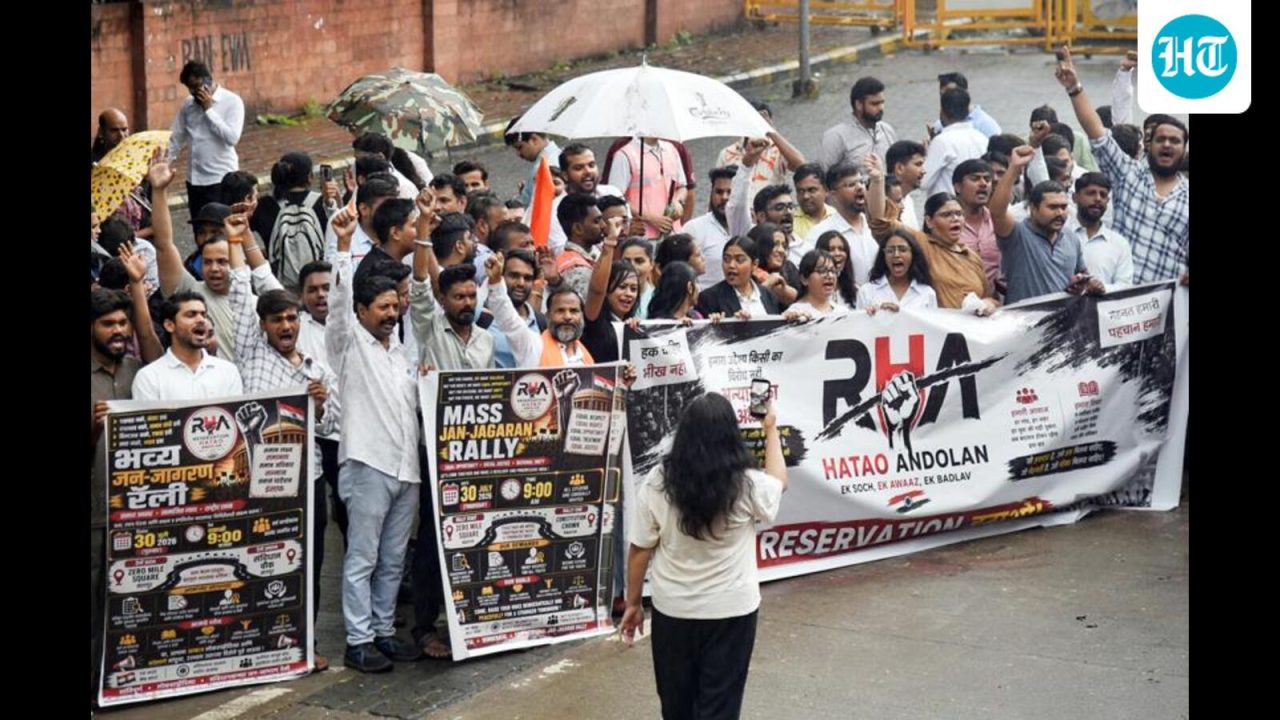
Over the decades, reservation has repeatedly been portrayed by opponents as an assault on merit. Upper-caste resentment has remained powerful even as some historically marginalised communities have gained greater political voice and social mobility. The anger has taken many forms, from dramatic protests against the Mandal recommendations to demonstrations that imagined reservation as a threat to futures that had never been guaranteed.
The central problem is the assumption that merit is produced in isolation. Access to schools, coaching, family guidance, social networks, interview referrals and economic stability can shape outcomes long before an examination or job application is submitted. Caste continues to influence entry into classrooms and campuses, chances of receiving job callbacks, intimate relationships, housing, grief and even burial or cremation spaces.
Harvard historian Ajantha Subramanian has shown how caste and merit are often made to seem naturally connected. This framing allows dominant groups to present their own position as detached from identity while depicting the assertion of rights by marginalised people as identity politics. The result is an especially convenient illusion: some people can imagine that they have moved beyond caste while continuing to benefit from social arrangements formed through it.
The contradiction is visible in the treatment of reservation itself. Many people who stigmatise students admitted through reserved categories do not apply the same language to beneficiaries of the economically weaker sections route, which effectively provides an upper-caste quota. The phrase “quota student” is not distributed evenly. Its use frequently reveals which forms of public support are treated as legitimate and which are marked as suspect.
Reservation Is Not the Same as Caste Discrimination
A damaging reversal has taken hold in public conversation: reservation is increasingly described as the principal form of discrimination, while caste discrimination is pushed into the background. This shifts attention away from those who exercise bias or profit from it and places it instead on Dalits and other marginalised groups seeking representation and access.
Political parties have often supported reservation because electoral realities demand it. But formal support has not always produced a broader commitment to social justice. Reserved positions may remain unfilled, institutions may fail to make campuses genuinely inclusive, and parties controlled largely by upper-caste leaders may rarely nominate Dalit candidates outside reserved constituencies.
These failures matter because reservation cannot carry the entire burden of equality. It is one mechanism for widening access, not a substitute for confronting exclusion in schools, workplaces, homes, neighbourhoods and political organisations. Treating it only as an electoral symbol empties it of its larger purpose: building a society in which dignity and opportunity are not governed by birth.
The Cost of Social Distance
The most troubling consequence of caste denial may be the erosion of empathy. It remains possible for an upper-caste Indian to move through life without close Dalit friends or colleagues, without sharing a home, forming an intimate relationship or standing alongside a Dalit family in mourning. Such separation makes it easier to see quotas as an abstract loss rather than as a limited response to unequal conditions.
Those who believe opportunities are theirs by unquestioned right may interpret reservation as theft. But that belief depends on overlooking the connections, community advantages and accumulated security that make certain opportunities easier to reach. Individual effort matters, but it does not begin from the same starting line for everyone.
The constitutional debate that began with a medical admission dispute has therefore never truly ended. India’s challenge is not simply to defend or oppose a quota. It is to recognise how caste continues to structure everyday life, and to understand that equality without social recognition can become another name for preserving unequal privilege.
Related Reading
Frequently Asked Questions
What is Caste bias has made empathy impossible?
Caste bias has made empathy impossible is the main topic of this guide. The article explains the context, practical details, and next steps readers should understand.
Why does Caste bias has made empathy impossible matter?
Caste bias has made empathy impossible matters because readers are looking for a useful answer, not just a short summary. Good content should match search intent and help them decide what to do next.