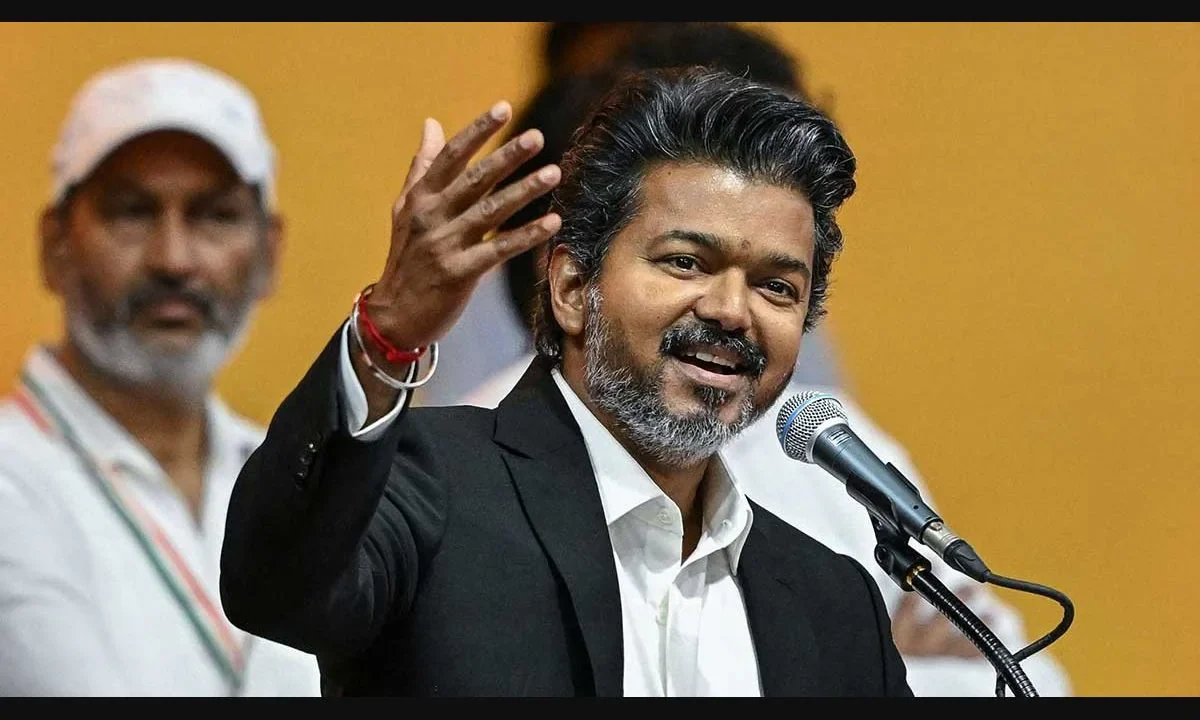

One Hundred Days of Statecraft: Vijay’s TVK Government Under Scrutiny
Indiadailyupdate.com – When C. Joseph Vijay stepped forward to take the oath of office on May 10, 2026, he walked into what many observers called one of India’s most complex administrative apparatuses with virtually no prior experience running a state. The Tamilaga Vettri Kazhagam (TVK) chief minister arrived as a political outsider, inheriting a bureaucracy shaped over decades by a rigid Dravidian duopoly. To those who questioned his readiness, he delivered a pointed retort:
“Yes, I am an actor, but I don’t act in politics.”
Yet the first hundred days have produced a picture far more disciplined than the sceptics anticipated. By holding together a wide coalition—Congress, VCK, the Communists, and the IUML—while quietly absorbing a substantial bloc of former AIADMK legislators, the TVK has carved out a governing identity that fuses populist energy with an unexpectedly detailed attention to institutional mechanics.
The Fiscal Gamble: Welfare Expansion Amid Debt
The administration inherited a fragile fiscal position weighed down by a heavy debt legacy. Orthodox economic doctrine would have prescribed immediate belt-tightening. Vijay went the opposite direction. His earliest policy moves included doubling the free electricity threshold from 100 to 200 units for middle-income households and rolling out a sweeping crop-loan waiver of up to ₹75,000 per individual farmer. Together, these commitments totalled nearly ₹6,000 crore.
The governing rationale behind this spending surge is that the state’s financial bleeding stems not from excess outlays but from broken institutional plumbing. To address this, the government constituted a Revenue Augmentation Committee (RAC) under the chairmanship of Montek Singh Ahluwalia, former deputy chairman of the Planning Commission. The committee carries a hard annual target of Rs. 16,000 crore in additional collections—not through fresh taxation, but by sealing leakages in high-yield sectors such as mining and the state-run TASMAC liquor retail network, and by dismantling the restrictive tender practices that have long served as conduits for kickbacks.
The TVK’s core fiscal thesis, and its single greatest financial risk, rests on a simple claim: the state need not slash expenditure if it can simply repair the revenue machinery.
“Uncle Vijay” and the Kinship State
Parallel to the fiscal agenda, the administration has pursued an aggressive strategy of populist institutionalisation—recasting the state from a remote bureaucratic apparatus into something resembling a caring family member. The most visible expressions of this are the Thaai Maaman Thanga Motiram Thittam (maternal uncle gold ring scheme) and the Annan seer (brother’s gift) programme. Under these, newborns receive one-gram gold rings, while brides are presented with eight-gram gold coins alongside silk sarees. In doing so, the government has stitched Vijay’s Jananayagan persona into the most intimate life-cycle rituals of every Tamil household.
Beyond symbolic jewellery, the administration launched the Mannin Magal Thittam, a scheme oriented toward gender-based asset redistribution through land ownership. Though initially modest, carrying a Rs. 20 crore allocation, the programme is designed to convert land titles held by women into durable rural wealth, catalysing a broader economic shift in agrarian communities.
By wrapping these initiatives in the vocabulary of kinship, Vijay is attempting to forge a base of social trust that sidesteps the traditional party-loyalty structures that have long governed Tamil Nadu’s political landscape.
The Ignorance Dividend and Zero Tolerance for Graft
Perhaps the most pointed—and paradoxical—observation about the TVK’s tenure is what analysts term the “ignorance dividend.” Tamil Nadu’s established parties had, over years, inherited systems adept at organising corruption into a predictable party fund. Arriving without that pre-existing infrastructure, the TVK ministers initially lacked the operational know-how to run such illicit networks. Bureaucrats report that visible corruption has simply declined because the new ministers have not yet learned how to extract their cut.
To exploit this narrow window of administrative inertia, the government opened a dedicated WhatsApp line for corruption complaints and shifted notoriously graft-prone processes—electricity board transfers among them—onto online counselling platforms. Still, experts caution that this transparency may prove ephemeral, a temporary star rather than a sustained practice, once the new leadership acclimates to the old machinery.
Related Reading
Frequently Asked Questions
What is From silver screen to statecraft?
From silver screen to statecraft is the main topic of this guide. The article explains the context, practical details, and next steps readers should understand.
Why does From silver screen to statecraft matter?
From silver screen to statecraft matters because readers are looking for a useful answer, not just a short summary. Good content should match search intent and help them decide what to do next.