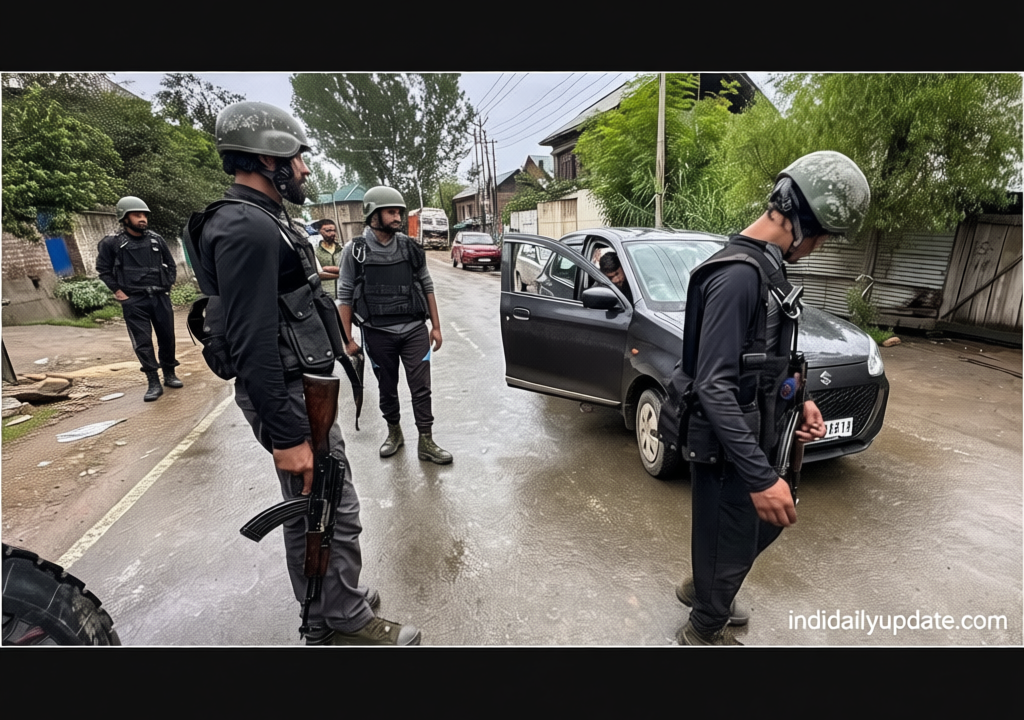

Recent Developments in Kashmir: Terror Network Exposed
Indiadailyupdate.com – Security agencies have uncovered a significant link between recent targeted killings in Jammu and Kashmir and a key militant leader. According to intelligence reports, Lashkar commander Latif Bhat linked to the orchestrated attacks on both security personnel and non-local laborers. The investigation reveals that Bhat played a central role in coordinating the elimination of a police constable in Anantnag alongside the murders of two non-Kashmiri workers in Kulgam district.
Reports indicate that Latif Bhat operated with crucial assistance from his close associate, Waris Shah. This companion provided essential logistical backing and reconnaissance services for the planned operations. The timing of these coordinated attacks suggests a well-planned strategy rather than isolated incidents. Security officials believe the attacks were timed to maximize impact while minimizing the risk of immediate apprehension.
Background: The Encounter That Changed Everything
Latif Bhat gained significant attention earlier this year when he found himself cornered alongside senior Lashkar-e-Taiba commander Zakir Ganai. According to NDTV’s comprehensive coverage, the two militants were trapped in an orchard after being detected by surveillance cameras. The subsequent five-day encounter resulted in Ganai’s elimination, while Bhat successfully escaped into the surrounding terrain.
Ganai’s body was eventually recovered from the Saidpora region in South Kashmir, marking a significant victory for security forces. However, Bhat’s escape raised concerns among intelligence agencies about his potential to regroup and continue his militant activities. His survival allowed him to maintain connections with existing terror networks in the region.
Security agencies have developed a theory that Bhat has successfully reactivated dormant sleeper cells across the Kashmir Valley. These cells are specifically tasked with carrying out targeted eliminations of non-locals and security personnel. The operational pattern suggests that Bhat may have received support from handlers based across the border in Pakistan, enabling him to coordinate attacks from multiple locations.
The modus operandi employed in these killings reveals sophisticated planning. Terrorists typically hide among local populations after executing their targets, making identification difficult. The use of pistols rather than heavy weapons facilitates this strategy, as attackers can blend seamlessly into crowds. This approach was evident in the Kulgam incident where Chhattisgarh natives Deepak Ratray and Bopinder, both in their twenties, were murdered at a brick kiln in the Kelam area during Friday evening.
Deepak Ratray died immediately at the scene, while Bopinder succumbed to his wounds during medical treatment. This attack follows a pattern of similar incidents across the region. On July 22, Jammu and Kashmir Police head constable Ashiq Hussain was shot dead by a lone terrorist in Anantnag’s Lal Chowk area while performing Amarnath Yatra duties. Earlier, on February 7, 2024, two Punjab workers—Amritpal Singh and Rohit Masih—were killed in Srinagar’s Shaheed Gunj locality.
Intelligence sources suggest that the reactivation of sleeper cells under Bhat’s command represents a renewed threat to non-local workers and security personnel operating in the Kashmir Valley.
The investigation into Lashkar commander Latif Bhat linked operations continues as authorities work to dismantle the entire network. Security forces have intensified surveillance in areas where sleeper cells are believed to be active. The pattern of attacks suggests that Bhat’s network remains operational and capable of launching coordinated strikes against its targets.
As investigations progress, more details about the command structure and funding mechanisms are expected to emerge. The connection between Bhat and the recent killings highlights the persistent challenge posed by organized terrorist networks in the region. Security agencies remain vigilant, monitoring movements and communications to prevent future attacks on both locals and non-locals in Jammu and Kashmir.