
Manipur’s Census Standoff Deepens as Valley Groups Demand Formal Written Order
Indiadailyupdate.com – Imphal’s streets fell silent on Tuesday morning as a 24-hour shutdown, called by the Campaign for Just and Fair Delimitation (JFD), brought the Imphal Valley districts to a standstill. The protest was triggered by what organisers describe as an incomplete government response: although the Union government announced on Monday that the upcoming Census enumeration would be deferred in Manipur, the Registrar General and Census Commissioner of India had still not published a formal written order in the government gazette. Until that document appears, JFD says the bandh will persist.
The standoff sits at the intersection of two deeply contested questions in Manipur’s fractured political landscape: whether a National Register of Citizens (NRC) should be updated before the 2027 population count, and whether the Census itself can proceed safely in a state still reeling from ethnic violence that has claimed roughly 300 lives since May 2023.
What Is Happening on the Ground
In Imphal, supporters of the shutdown were observed blocking major arterial roads, halting vehicular movement across the Valley. At Khwairamband Ima Market, one of the city’s busiest commercial hubs, vendors launched an indefinite sit-in beginning at Tuesday midnight, effectively shutting down trade in the area. The action paralysed daily life across the Valley districts from early Tuesday onward.
JFD convener Jeetendra Ningomba made the group’s position explicit: the shutdown will not be lifted until the postponement is formally notified in the government gazette. In his framing, a verbal or press-release announcement by the Union government is insufficient; only a gazetted order from the Census Commissioner carries the legal weight needed to suspend operations.
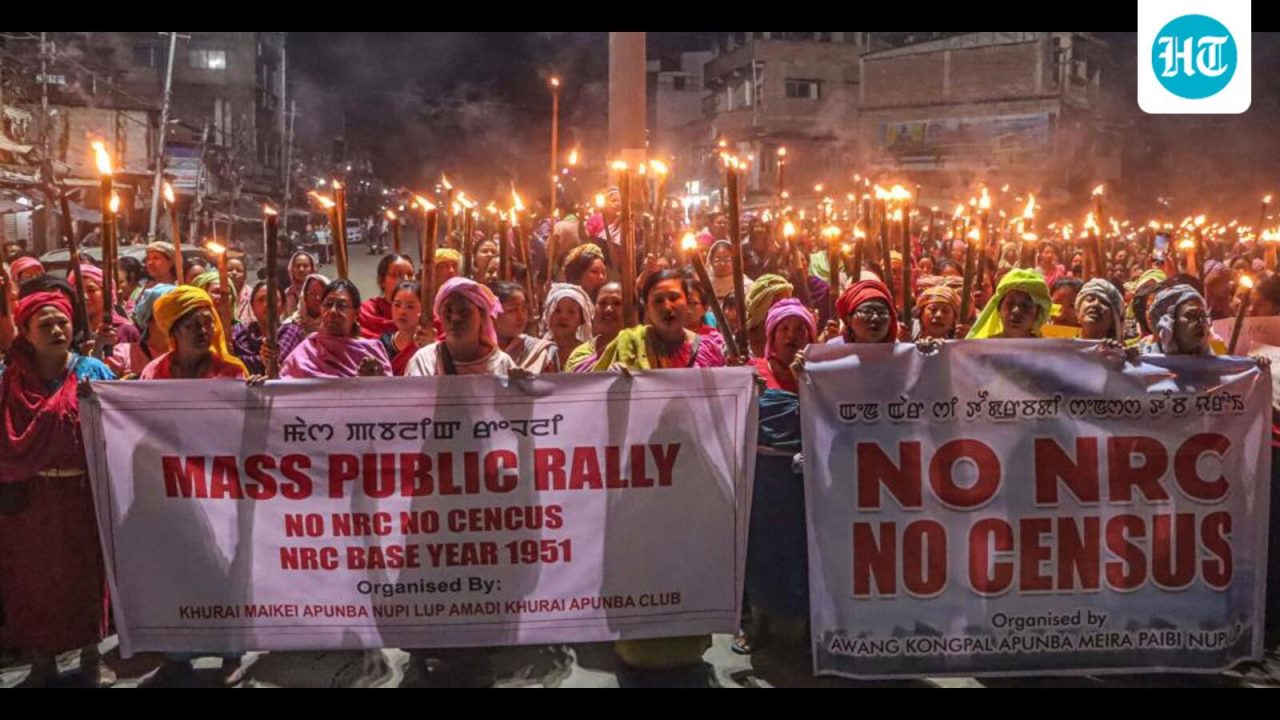
The agitation has also taken a more confrontational form. JFD’s student wing carried out a lockdown of the Directorate of Census Operations in Manipur, while torch rallies were organised in several parts of the state, concentrated in the Imphal Valley. These actions underscore the intensity with which the group views the Census question as an existential demographic issue rather than a routine administrative exercise.
The Core Demand: An Updated NRC Before Enumeration
Meitei and Naga community organisations have been staging protests since August 16, pressing for a refreshed NRC to precede any Census count. Their argument centres on what they describe as the risk of “demographic changes” if enumeration proceeds without first establishing who qualifies as a citizen resident of the state. The concern is sharpened by Manipur’s shared border with Myanmar, where decades of cross-border movement have led communities to fear that an unvetted count could inadvertently register persons they consider illegal immigrants.
For these groups, the Census is not merely a headcount. It feeds into delimitation of electoral constituencies, allocation of resources, and the broader question of political representation. An enumeration conducted without a prior citizenship screen, they argue, could entrench a demographic shift that would be extremely difficult to reverse in subsequent decades.
The Kuki-Zo Counter-Argument
The Kuki-Zo communities, concentrated in the hill districts of Manipur, have taken the opposite position. The Kuki-Zo Council (KZC), the apex body representing these communities, has labelled the call for an NRC before the Census as
“premature and unjustified.”
The KZC points to the Assam precedent as a cautionary tale. Under the Assam Accord of 1985, the state compiled an NRC that excluded approximately 1.9 million people from the final list. Those exclusions triggered years of litigation and appeals before Foreigners Tribunals, leaving countless families in legal limbo. The KZC contends that replicating that process in Manipur, without equivalent safeguards, would deepen communal fault lines rather than resolve them.
Government Response and Judicial Intervention
The Union government’s decision to defer the Census came just one day before the house-listing phase was set to commence in Manipur. House-listing is the preliminary stage in which enumerators visit every dwelling to compile a master list of households; it is the logistical backbone upon which the actual count is built. The postponement was announced after Union Home Minister Amit Shah chaired a review meeting in New Delhi to “assess the current situation” in the state. The chief minister’s office stated that the decision was taken in consideration of the feelings and aspirations of Manipur’s people.
Meanwhile, the Manipur High Court intervened on Monday, directing that the house-listing exercise be kept in abeyance pending further notification. The court is also hearing petitions that seek a judicially supervised updated NRC before any Census activity resumes. Its interim direction remains in force until the next hearing, scheduled for October 12.
Why This Moment Matters
Manipur’s ethnic violence, which erupted in May 2023 along Meitei–Kuki-Zo lines, has left the state’s social fabric severely damaged. Inter-communal trust, already fragile, makes any exercise perceived as favouring one group’s demographic interests over another’s a potential flashpoint. The Census, ordinarily a quiet bureaucratic process, has thus become a proxy battleground for questions of belonging, citizenship, and political power in a state that has yet to fully recover from its worst communal crisis in decades.
Until the gazette order materialises, until the High Court resolves the pending petitions, and until the competing community positions find some form of negotiated accommodation, the shutdowns, sit-ins, and rallies in the Imphal Valley are likely to continue. The question Manipur now faces is not simply when the Census will resume, but whether the state can design a process that its divided communities will accept as legitimate.
Related Reading
Frequently Asked Questions
What is Manipur?
Manipur is the main topic of this guide. The article explains the context, practical details, and next steps readers should understand.
Why does Manipur matter?
Manipur matters because readers are looking for a useful answer, not just a short summary. Good content should match search intent and help them decide what to do next.