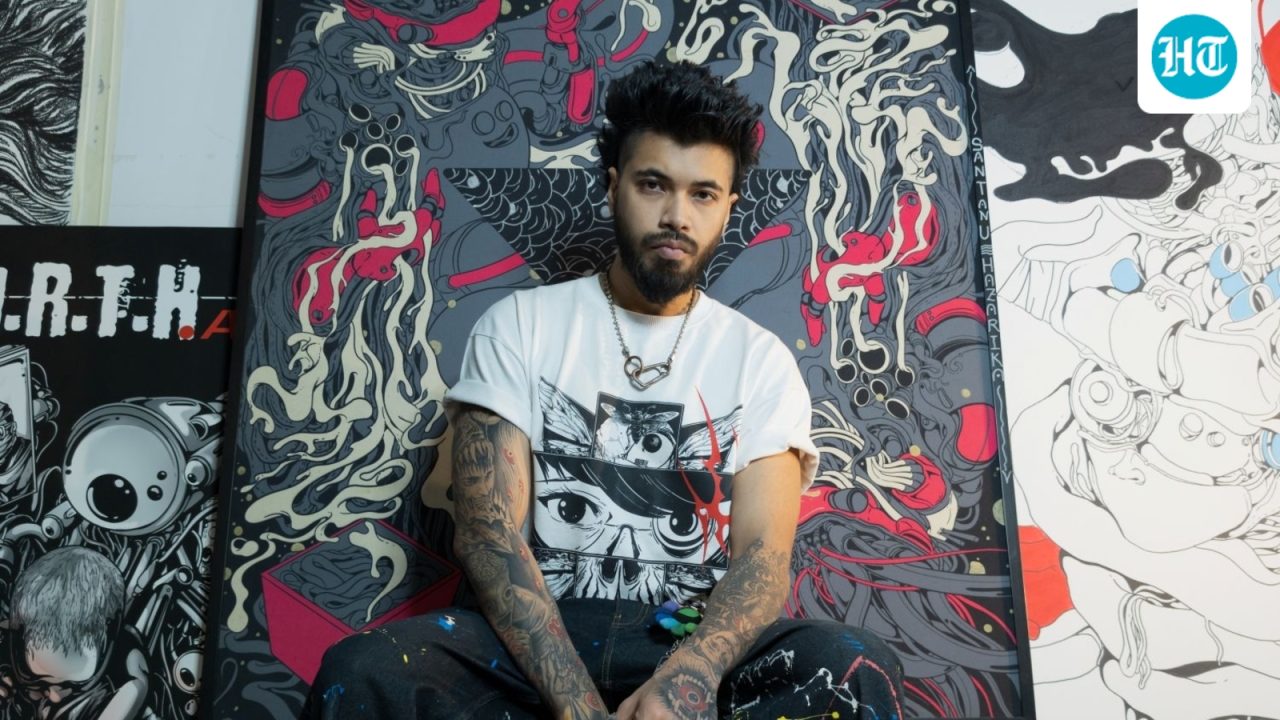
From Doodle Champion to Multidisciplinary Creative Director: Santanu Hazarika’s Expanding Canvas
Indiadailyupdate.com – When Santanu Hazarika chose art over engineering in 2014, the decision went against a path many Indian families considered dependable. The Assam-born creator was stepping away from a conventional professional route to pursue doodling, an art form still unfamiliar to many people as a serious career option.
That leap soon brought a defining breakthrough. Hazarika won the first Red Bull World Doodle Art Championship, representing India on an international platform and gaining the confidence to make visual art his full-time direction. The recognition helped him challenge expectations at home and showed that a creative practice could become a viable career.
For years, the description “doodle artist” became attached to his name. While he acknowledges its importance in helping him establish himself, he no longer sees it as an adequate description of what he does.
“I don’t kind of use the title anymore because I have kind of grown beyond it,” Santanu said.
His work now extends far beyond drawing. Hazarika operates across creative direction, murals, visual-art projects, custom design and branded collaborations. The label that first brought him attention remains part of his story, but it does not contain the breadth of his current practice.
“The title was sort of like a means to an end; it really helped me get my footing, change my track, and winning the world championship gave me that confidence. It also helped me break many stereotypes back home so I could pursue art or design as a career. But that was just a side of me. Now I work as a creative director on multiple projects and visual arts initiatives. It’s actually more three-dimensional than just being labelled as an artist at this point,” he added.
A self-built visual education
Hazarika did not attend art school, but he developed his own ongoing education through close observation and experimentation. Japanese manga, Renaissance-era art, heavy-metal album art and graffiti in Guwahati all became points of reference. Rather than separating high art from popular culture or street expression, he drew ideas from each of them.
That curiosity continues to shape his approach. New tools and changing formats have not replaced his foundations; they have given him more ways to develop them. For an artist working across physical and digital spaces, staying open to unfamiliar methods is as important as retaining a recognisable visual voice.
“The learning period has always been there,” he said. “Even now, at this point, I’m learning every day. Everything: new skills, new media, be it AI or new technologies coming around. The first stepping stone was quite exciting for me because everything felt new. Every opportunity felt like a potential track or a potential lesson. The words I would use are ‘intriguing excitement.’”
That self-directed method helps explain the range of his portfolio. Hazarika has created large-scale murals and customised motorcycles, while also working on visuals connected with musicians including Divine, Seedhe Maut, Raftaar and Nucleya. His projects have also included digital assets for Nothing and a collaboration with Adobe.
The variety can make his career appear agency-like in scale, but the underlying approach remains consistent. A wall, a vehicle, footwear, a digital composition or a sports jersey may demand different production techniques, yet he treats each as a new surface for the same core visual process.
“I have a distinctive art style and a distinctive process. Essentially, it’s the process which defines the outcome, and I feel like I’ve stuck to that single process almost my whole life. It’s only the technicalities of work that change with different mediums, but the core of it, the essence, and the process more or less remain the same. You need a good anchor point to fall back on, sequence by sequence, irrespective of the medium.”
Bringing Assamese identity into global design
One of Hazarika’s most visible recent applications of this philosophy came through his work for Konami’s eFootball franchise. Asked to design custom sportswear for the global video-game property, he did not rely only on expected futuristic gaming imagery. Instead, he looked to a deeply familiar cultural reference from Assam: the gamusa.
The red-and-white woven cotton cloth is closely connected with Assamese identity. Hazarika used its colour language and structural qualities as a starting point for the jersey design, translating its presence into a contemporary sportswear format. The result was not a literal reproduction of a traditional textile, but a reworking of its visual essence for a different audience and medium.
“How I stay rooted is the fact that I am rooted. It has never been the case that I try to force my cultural identity into everything, rather than keeping it in a nice balance. For a project like the eFootball jersey, I moulded Assamese identity. I stripped it down to the basic colours of the very thing that gives us an identity — which is the gamusa,” he shared.
The balance was deliberate. Hazarika described the design as a 60-40 equation: 60 percent focused on how the jersey should work and look as sportswear, and 40 percent informed by the gamusa and his Assamese roots. That calculation allowed the regional influence to inform the design without overwhelming its functional purpose.
“The ratio was more or less 60-40, with 60 percent being the idea of the jersey, how the aesthetics were going to look, the sportswear, and 40 percent being inspired by everything that is gamusa and my roots. So that’s how I play with the game of ratios,” he explained.
Creating more room for Northeast voices
Hazarika’s use of cultural references is rooted in lived experience rather than decorative symbolism. His work suggests that local identity can travel across industries, from music and technology to gaming and fashion, without being reduced to a superficial visual marker.
He is also taking that idea beyond individual commissions. Hazarika is building an artist and music residency in Assam, intended to encourage exchange between creative communities in the Northeast and elsewhere in India. Such spaces can give artists opportunities to meet, collaborate and develop work while bringing greater attention to perspectives that have often remained outside India’s major creative centres.
His journey offers a broader lesson for emerging artists: a career need not be limited by the first style that earns recognition. For Hazarika, doodling opened the door, but continual learning, adaptability and a strong sense of place have enabled him to keep moving through it.
Related Reading
Frequently Asked Questions
What is Meet Assamese artist Santanu Hazarika who quit?
Meet Assamese artist Santanu Hazarika who quit is the main topic of this guide. The article explains the context, practical details, and next steps readers should understand.
Why does Meet Assamese artist Santanu Hazarika who quit matter?
Meet Assamese artist Santanu Hazarika who quit matters because readers are looking for a useful answer, not just a short summary. Good content should match search intent and help them decide what to do next.