
Veteran Actor Naseeruddin Shah Tells NEET-UG Student Protestors: “I Wish Them More Strength”
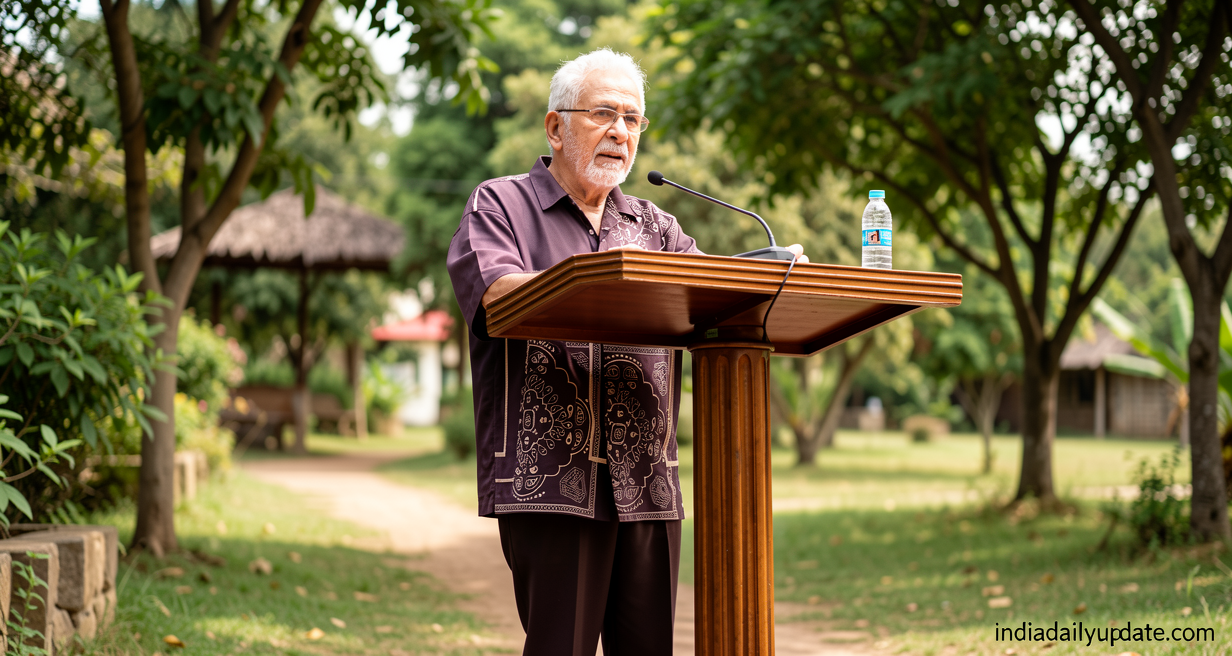
Indiadailyupdate.com – More than a month after releasing a fiery video that drew both praise and sharp backlash across Indian social media, veteran actor and theatre director Naseeruddin Shah returned to the issue of student protests over the NEET-UG examination controversy. Speaking in Delhi on Sunday, the 76-year-old performer told a gathered audience that he hopes the young demonstrators continue to find the resolve to press their demands.
“I wish these kids all the best, and I wish them more strength.”
Shah made the remark on the margins of a literary event in the capital — the launch of Mahmood Farooqui’s memoir The Tihar Players, a book chronicling the playwright’s years inside Tihar Jail and the drama workshops he conducted behind bars. Asked directly whether he thought sustained student agitation could alter the political landscape, Shah offered an unambiguous answer.
“This kind of protest will definitely work.”
Background: The NEET-UG Uprising and Shah’s July Video
The comments come in the wake of a nationwide student movement that erupted in mid-2024 after allegations of question-paper leaks and administrative irregularities in the National Eligibility cum Entrance Test for Undergraduate medical courses. Tens of thousands of aspirants, many of whom had prepared for years, took to the streets in Delhi and other cities demanding a fresh examination cycle. Police responded with baton charges and tear gas, and footage of lathi-charged students circulated widely online.
In July, Shah posted a video in which he drew a pointed parallel between the Delhi Police officers who charged the demonstrators and American Immigration and Customs Enforcement (ICE) agents — a comparison that amplified the clip’s reach. He also directed a barbed remark at senior Bollywood actors who had remained conspicuously silent while students were being beaten on the streets. The video ignited a firestorm of debate. Kangana Ranaut and lawyer Piyush Mishra were among the most vocal critics, each publishing their own rebuttals on social platforms.
A Stage Born of Confinement
The event at which Shah spoke carried its own layered significance. The Tihar Players documents Farooqui’s decision to teach acting and improvisation to fellow inmates during his incarceration. At the launch, a troupe of former Tihar Jail residents performed a short theatrical piece drawn from those prison workshops. Shah, who has spent decades shaping young performers through his own theatre company and mentorship programmes, was visibly moved.
“Seldom have I seen this much truth in a performance, performed by those who have gained redemption.”
The remark underscored a theme that runs through much of Shah’s public commentary: that authentic artistic expression often emerges from conditions of constraint and suffering rather than from the comfortable studios of the entertainment industry.
On Training, Inhibition, and the Question of Purpose
During an on-stage conversation with Farooqui, Shah turned to the practical question of how actors shed self-consciousness. He described watching his own students — many of whom attend drama classes primarily as a ticket to employment in the film industry — stumble over even the most elementary exercises.
“I find that many of my student actors struggle to shed their inhibitions even in simple exercises such as drinking from an imaginary cup, and the women resort to crying after reading an imaginary break-up letter from their boyfriends, mainly because they join these classes to get a job. But I’m sure you didn’t get this struggle in the jail.”
The observation highlights a tension that has long animated Indian theatre pedagogy: the gap between actors who approach craft as a vocation and those who treat it as a career ladder. Shah’s implication is that the existential stakes of Farooqui’s prison workshops — where performance was an act of survival and self-reclamation — produced a rawness that classroom training, however rigorous, rarely replicates.
Boarding School as Proto-Prison
Shah also drew a personal parallel, recalling his own years at a strict boarding school and comparing the regime of corporal and verbal punishment there to incarceration. He noted that the discipline meted out by schoolmasters decades ago would be unthinkable in today’s educational environment.
“The teachers today would be arrested,”
he quipped, to laughter from the audience. The aside, light in tone, nonetheless pointed to a broader cultural shift in how Indian institutions treat authority, discipline, and the rights of young people — a shift that the NEET-UG protesters, in their own way, have been testing at the street level.
Why the Moment Matters
Shah’s public interventions — from his decades-long work with the National School of Drama and his own theatre company to his occasional political commentary — have made him one of the most recognisable cultural voices in India. When he speaks about student agency, artistic truth, or institutional accountability, the remarks land with a weight that purely political commentary often lacks. His insistence that protest “will definitely work” arrives at a moment when Indian students are recalibrating their relationship with state institutions, and when the question of whether cultural figures should speak alongside political movements remains fiercely contested. The answer, in Shah’s case, has been consistent: the stage and the street are not separate arenas, and silence in the face of injustice is itself a performance choice.
Related Reading
Frequently Asked Questions
What is Naseeruddin Shah wishes more strength to student?
Naseeruddin Shah wishes more strength to student is the main topic of this guide. The article explains the context, practical details, and next steps readers should understand.
Why does Naseeruddin Shah wishes more strength to student matter?
Naseeruddin Shah wishes more strength to student matters because readers are looking for a useful answer, not just a short summary. Good content should match search intent and help them decide what to do next.