Modi Turns SRCC Centenary Stage Into Platform for Political Barbs and Pakistan Warning
Indiadailyupdate.com – Delhi University’s Shri Ram College of Commerce marked its 100th anniversary on Saturday with a ceremony that quickly became a stage for Prime Minister Narendra Modi to deliver a pointed political message. Speaking before students, faculty, and alumni gathered for the milestone event, the Prime Minister wove together institutional congratulations, a fresh jab at opposition leaders, and a renewed military threat directed at Pakistan — all within the span of a single address.
The “Dimaagi Naxal” Dig Returns
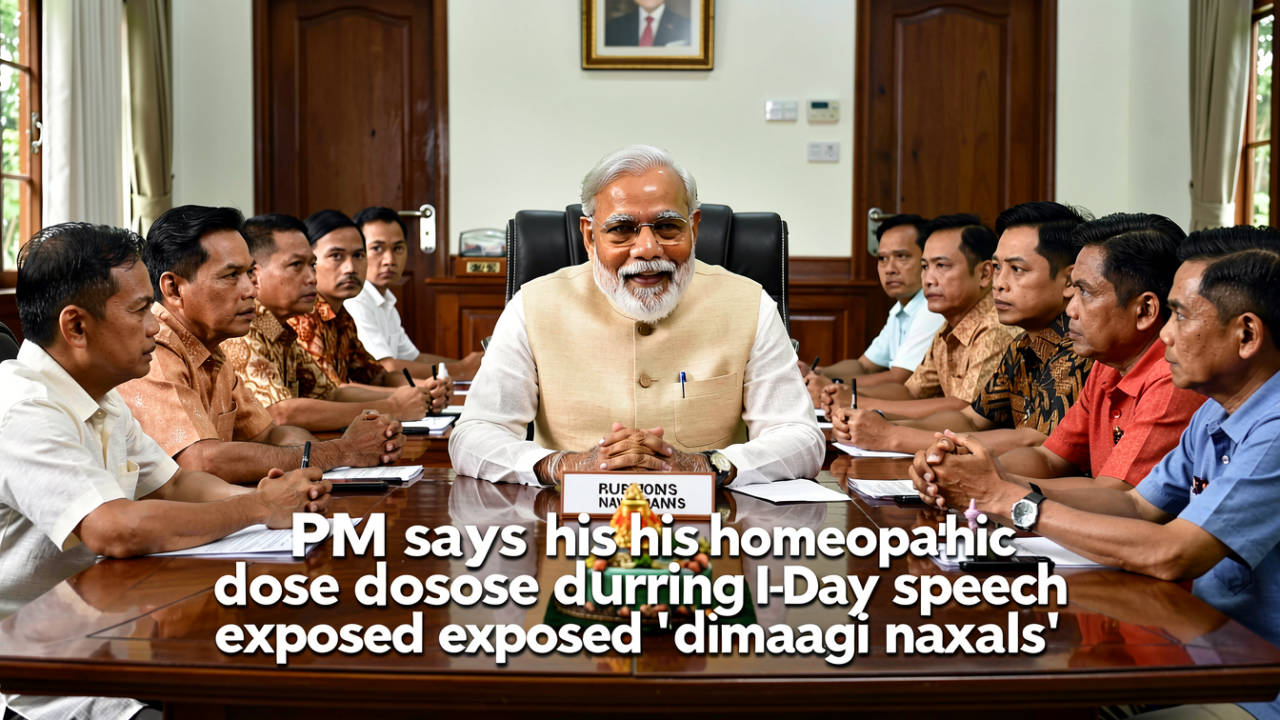
Modi revisited a phrase that has become a recurring motif in his rhetorical arsenal: the accusation that certain political opponents are “dimaagi naxal” — brain naxals, or ideologically infected rebels of the mind. He framed the remark as a follow-up to comments he made during his Independence Day address from the Red Fort the previous month, suggesting that his earlier words had effectively exposed those he considered intellectually dishonest.
“Jaise hi maine dimaagi naxal wali homepathy ki goli di, sare dimaagi naxal nikal nikal ke bahar aanay lage aur jo is bimari ko badhawa de rahe hain ab janta unka bhi asli rang dekh rahi hai.”
Translated loosely, the Hindi passage likens his Independence Day remark to a homeopathic dose that flushed out every “brain naxal” into the open, while the public now sees the true colours of those who nurture the affliction. The metaphor — comparing political disagreement to a medical condition requiring a tiny, almost symbolic remedy — has become a signature device in Modi’s campaign-style speeches, blending colloquial Hindi with political theatre.
The choice of venue amplified the contrast. SRCC, one of India’s most prestigious economics colleges, has long been associated with technocratic and liberal-intellectual traditions. Delivering a populist political barb inside its centenary auditorium underscored the Prime Minister’s strategy of inserting partisan messaging into institutional and ceremonial settings.
Pakistan Warning: “They Enter Our Homes and Strike”
Shifting tone within minutes, Modi issued what he described as a direct warning to Islamabad. He stated that if Pakistan attempts terrorist operations on Indian territory, Indian armed forces will respond by entering Pakistani territory and striking back at the source.
“Today, those spreading terrorism are on the back foot. If Pakistan indulges in any misadventure, India’s armed forces will enter their territory and strike.”
He reinforced the point with a Hindi phrase — “ghar mein ghuske maarte hain” — meaning that India goes into the enemy’s home and delivers the blow. The rhetoric echoes language Modi has used since the 2019 revocation of Article 370 and the 2025 cross-border tensions, framing India’s military posture as both defensive and preemptive. The warning came amid heightened border alertness and periodic skirmishes along the Line of Control, lending the statement immediate geopolitical weight.
From Policy Paralysis to Policy Dynamism
In a broader domestic assessment, Modi claimed measurable progress across several fronts. He pointed to reduced violence in Jammu and Kashmir and the Northeast, declared that the back of Maoist insurgency and Naxalism had been broken, and contrasted what he called the world’s earlier concern over India’s “policy paralysis” with its current discussion of India’s “policy dynamism.”
“Peace has increased from Jammu and Kashmir to the Northeast. The back of Maoist terrorism and Naxalism has been broken. The world that was once concerned about India’s policy paralysis is today talking about India’s policy dynamism.”
These claims align with government narratives that have accompanied the post-2019 security architecture in Kashmir and the intensified counter-insurgency operations in central India. Critics, however, continue to question whether the reduction in reported incidents reflects structural change or primarily a shift in reporting and operational tempo.
Celebrating a Century of Economic Education
Setting aside the political overtones, Modi extended formal congratulations to SRCC’s community on the centenary. He described the occasion as historic not only for the college but for India’s wider education sector, noting that multiple generations of SRCC graduates were assembled in one room for the first time in the institution’s history.
“Today’s occasion is very historic for Shri Ram College of Commerce. It is equally important for the education sector of the country. Numerous generations that have been part of SRCC are gathered together here. I extend my heartiest congratulations to all of you for SRCC’s centenary celebration.”
Modi went on to praise the college’s alumni network, adopting the slang term “OGs” — a nod to contemporary youth culture meaning original, pioneering figures — to describe graduates who had carried the SRCC name into global professional arenas.
“The alumni of SRCC have also been very special. In your language, I would say the alumni here are the OGs. They have taken the name of SRCC across the world and made a mark for themselves in different fields.”
He singled out former Finance Minister Arun Jaitley, who died in 2023, recalling that Jaitley frequently recounted anecdotes from his SRCC days during meetings, sometimes repeating the same story to the point of mild exasperation. Modi also named economist Sanjeev Sanyal, a member of his advisory team, as another distinguished alumnus. He stressed that the college’s output extends well beyond economics into art, politics, law, and the judiciary.
“Our Arun Jaitley studied here. And I can say that perhaps there was hardly a meeting with him where he did not share an incident from his SRCC days. Sometimes I would get tired because he would tell me the same incident again and again. Even today, Sanjeev Sanyal, who is part of my team, is an alumnus of SRCC. We have many other colleagues who studied here as well. And it is not that SRCC has produced people only from the world of economics. From artists to politicians, lawyers and judges, people from every field have emerged from here.”
Context and Implications
SRCC, established in 1925, occupies a singular position in Indian higher education: it is the country’s oldest dedicated economics college and has trained generations of policymakers, central bankers, and corporate strategists. Its centenary falls at a moment when India’s economic policy apparatus is undergoing rapid expansion, making the institution’s symbolic weight particularly visible to a government eager to associate itself with elite academic legitimacy.
The decision to deliver a politically charged address at such a ceremony — rather than limiting remarks to institutional congratulations — reflects a broader pattern in which Modi’s public appearances blend ceremonial duties with campaign messaging. For the college’s community, the centenary thus carried a dual resonance: genuine institutional pride alongside the unavoidable reality that the most prominent voice in the room was using the occasion to advance a partisan narrative. The event, reached by the Prime Minister via Delhi Metro in a deliberate display of accessibility, underscored how ceremonial milestones in India’s academic calendar increasingly intersect with the rhythms of electoral politics.
Related Reading
Frequently Asked Questions
What is PM Modi says his homeopathic dose?
PM Modi says his homeopathic dose is the main topic of this guide. The article explains the context, practical details, and next steps readers should understand.
Why does PM Modi says his homeopathic dose matter?
PM Modi says his homeopathic dose matters because readers are looking for a useful answer, not just a short summary. Good content should match search intent and help them decide what to do next.