
Survivors Emerge from Nepal’s Flood-Wrecked Infrastructure After Ten Days of Silence
Indiadailyupdate.com – Ten days after catastrophic flooding swept through Nepal’s mountain valleys, rescuers confirmed two more survivors pulled from the wreckage — a Chinese national extracted from beneath a hydropower tunnel and a woman freed from a collapsed home in the town of Nuwakot. The announcements, made Saturday by Nepali military and government officials, offered a narrow but significant reprieve in what has become one of the deadliest natural disasters in the country’s recent history.
The Tunnel Rescue at Trishuli
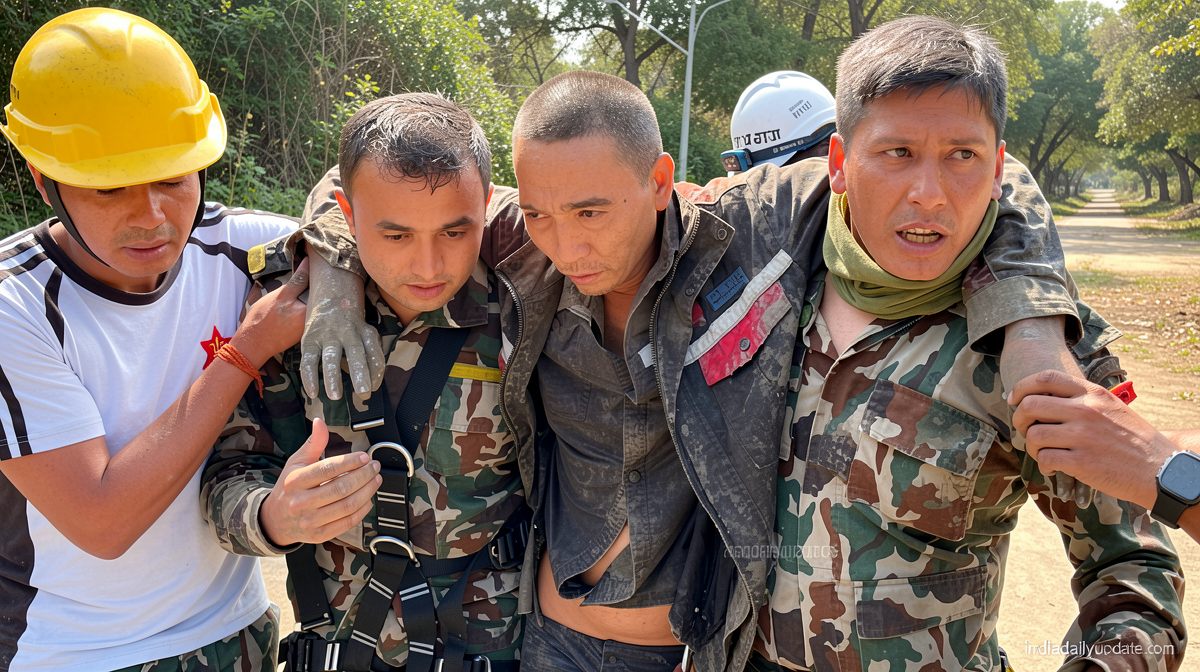
The Chinese worker was pulled alive from a 225-meter (approximately 738-foot) tunnel at the Trishuli hydropower project, according to a statement issued by the office of Nepal’s prime minister. His extraction brought the confirmed number of living workers recovered from that specific site to three. Two Nepalese laborers had been pulled from a tunnel at the Trishuli 3A plant the previous day, Friday, in what marked the first confirmed survivors from that facility’s buried infrastructure.
Nepal’s army detailed the operation: a combined team comprising Nepali military personnel and South Korean disaster-response specialists worked to reach the trapped man. Once freed, he was placed under immediate medical evaluation. Footage circulating afterward showed the survivor being airlifted by helicopter, with an army medic seated beside him, monitoring his condition during the flight. Separately, a photograph distributed by China’s state broadcaster CCTV captured the moment two rescuers carried him out of the tunnel mouth, his body supported between them as he left the confined space behind.
The survival of a worker after ten days inside a submerged or debris-filled tunnel raises questions about the structural integrity of Nepal’s rapidly expanding hydropower network. Engineers and disaster analysts have long warned that many of the country’s tunnel-based projects, built on tight timelines and in geologically unstable terrain, may lack the redundancy needed to protect workers when catastrophic water events strike. The fact that three individuals were found alive at Trishuli — while hundreds remain unaccounted for at other sites — underscores both the difficulty of the search and the narrow window in which survival becomes possible.
A Woman Freed in Nuwakot
In a separate operation Saturday, Nepal’s army spokesperson confirmed that a woman was rescued alive from a house in the flood-devastated town of Nuwakot. Officials stated she was being airlifted to Kathmandu for treatment. Released imagery showed rescuers hauling her from the structure, her body wrapped in a gray blanket as she was carried clear of the debris.
Nuwakot, situated along the Trishuli River corridor, was among the hardest-hit settlements when the floodwaters arrived. Entire neighborhoods were reduced to rubble, and the town’s infrastructure — roads, bridges, power lines — was severed, isolating communities for days and complicating both rescue and relief operations.
The Scale of the August 26 Catastrophe
The floods that triggered this prolonged rescue effort struck on August 26, and their origin is widely attributed to a glacier collapse that sent an enormous pulse of meltwater and debris cascading down Nepal’s river systems. Nepal’s disaster management agency has placed the confirmed death toll at no fewer than 1,300, while more than 5,000 people remain listed as missing. Those figures are expected to shift as search operations continue and as bodies are recovered from remote valleys where access remains limited.
Among the missing, approximately 900 workers are unaccounted for across 12 hydropower projects scattered throughout the country. Authorities estimate that roughly 500 of those workers are trapped inside various tunnels — enclosed concrete or rock-lined passages that, once flooded or buried, become lethal environments within hours. The combination of depth, water pressure, and limited air pockets makes tunnel rescues among the most technically demanding tasks in disaster response.
Why Ten Days Matters
In conventional search-and-rescue doctrine, the probability of finding a survivor alive drops sharply after the first 72 hours. Extending that window to ten days — as happened at Trishuli and in Nuwakot — is exceptional. It typically implies that the survivor was sealed in a small air pocket, shielded from direct water immersion, and sustained by minimal oxygen reserves. Each such recovery, while deeply encouraging, also highlights the staggering scale of what remains: hundreds of workers still unlocated, thousands of civilians still unaccounted for, and entire communities whose infrastructure has been erased.
The involvement of South Korean disaster experts in the Trishuli operation reflects a broader pattern of international technical assistance flowing into Nepal following the August 26 event. South Korea has maintained a long-standing disaster-management partnership with Nepal, and its teams have been deployed to multiple sites since the floods began. Their presence in the tunnel operation suggests that the rescue required specialized equipment and expertise beyond what local teams could deploy independently.
As Saturday’s announcements settled over a country still reeling from the worst flooding in decades, the two survivors became symbols of both endurance and urgency. They confirmed that life persists in places where death was assumed. They also sharpened the focus on the hundreds still unseen, turning every subsequent hour of search into a race against geological time.
Related Reading
Frequently Asked Questions
What is Chinese national rescued alive from hydropower?
Chinese national rescued alive from hydropower is the main topic of this guide. The article explains the context, practical details, and next steps readers should understand.
Why does Chinese national rescued alive from hydropower matter?
Chinese national rescued alive from hydropower matters because readers are looking for a useful answer, not just a short summary. Good content should match search intent and help them decide what to do next.