Abhishek Banerjee Slams BJP Goons for Theft in Uniform as Calcutta High Court Halts Demolition at TMC MP’s Office
High Court Orders Temporary Suspension of Demolition
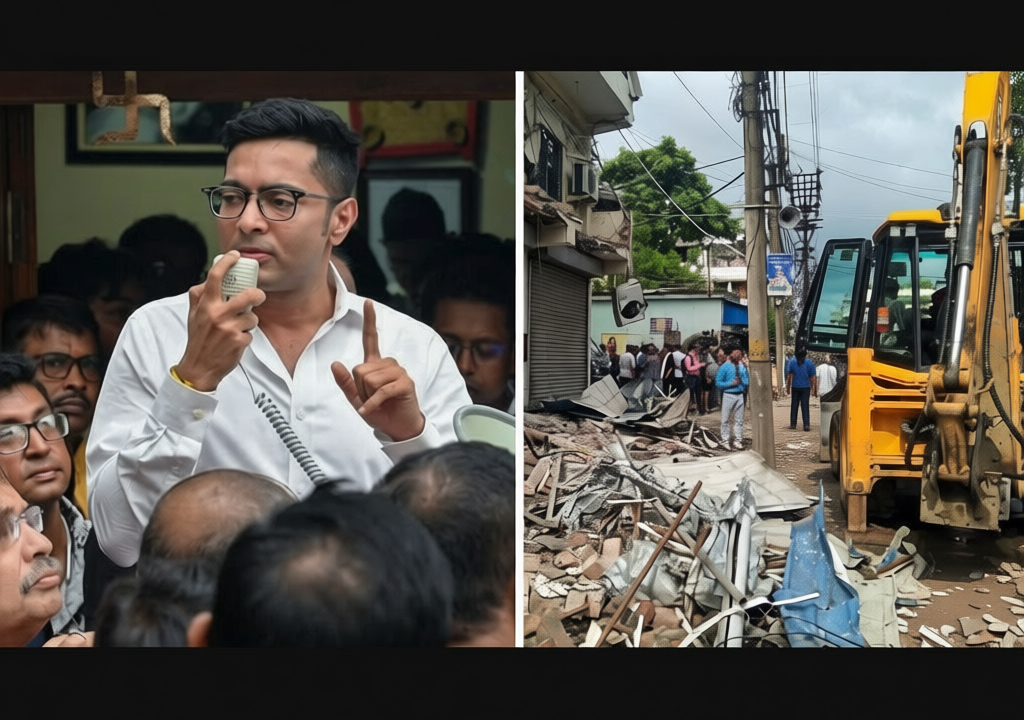
Indiadailyupdate.com – Calcutta High Court has temporarily suspended the demolition of the office belonging to TMC MP Abhishek Banerjee in Amtala, South 24 Parganas, following a petition filed by his firm, Leaps and Bounds. The court’s directive came after the MP condemned the action as a “theft in uniform” orchestrated by BJP supporters. The incident unfolded just a day after a bulldozer damaged parts of the building, sparking immediate legal intervention. The interim order mandates that all parties preserve the premises until further legal proceedings or a final ruling is issued, underscoring the urgency of the case.
Demolition Sparks Political and Legal Controversy
The demolition operation began on Saturday, with police and central forces cordoning off the premises. Despite the petitioner’s claim of valid land records, the action proceeded without clear justification. Abhishek Banerjee’s legal team argued that the operation was a coordinated effort to target his office, labeling the participants as “BJP goons” and accusing them of exploiting official authority. The TMC further alleged that the police were influenced by BJP-linked groups, leading to a sharp political clash. This incident has intensified scrutiny over the conduct of law enforcement and the role of political affiliations in administrative decisions.
The MP’s office, which has been a hub for local political activities, was reportedly ransacked by individuals in uniform. Footage shared on social media showed police personnel and BJP supporters removing laptops, printers, and other documents, suggesting a deliberate attempt to seize evidence or disrupt operations. Banerjee’s use of the term “theft in uniform” has drawn widespread attention, as it highlights the perceived misuse of power by those in authority. Legal experts have noted that such actions could be interpreted as a violation of procedural fairness, especially since the demolition occurred without prior notice or a formal legal order.
Historical Context of TMC’s Allegations
This is not the first time the TMC has raised concerns about targeted attacks on their offices. Following the announcement of Assembly election results, the party alleged that their office was attacked by BJP-aligned groups, accusing the police of failing to act promptly. The current case builds on that narrative, with Banerjee emphasizing a pattern of politically motivated actions. The TMC claims that the demolition was part of a broader strategy to intimidate opposition members and undermine their influence. These allegations have been met with mixed reactions, with some supporters calling it a necessary measure to enforce legal compliance, while critics argue it reflects a deeper ideological conflict.
Legal documents submitted by Banerjee’s team detail the sequence of events leading to the demolition, including the overnight deployment of bulldozers and the presence of BJP members at the site. The MP’s firm has highlighted the lack of transparency in the process, asserting that the operation was executed under the guise of administrative tasks. The Calcutta High Court is now tasked with determining whether the action was justified or if it constitutes an abuse of power. The ruling has sparked debates about the balance between law enforcement and political accountability, with many questioning the impartiality of the police in this context.
Public Reaction and Social Media Surge
“This is not just a demolition—it’s a theft in uniform, carried out with total disregard for the rule of law,” Banerjee wrote on X, channeling growing public outrage. His statement resonated with many citizens, who viewed the incident as a symbol of political dominance over local governance. Social media platforms have seen a surge in discussions, with users condemning the actions of BJP supporters and calling for transparency in the demolition process. The term “theft in uniform” has become a rallying cry, used to emphasize the perceived corruption and misuse of power by those in official roles.
Analysts have pointed out that the use of the phrase “theft in uniform” underscores the significance of the issue, as it ties the action to both legal and moral implications. The incident has also raised questions about the role of political parties in influencing law enforcement decisions, with critics suggesting that the BJP’s presence at the site indicates a deliberate effort to control the narrative. The TMC has leveraged the event to rally support, framing it as a victory against unchecked executive power and highlighting the need for judicial oversight in administrative actions.
Political Implications and Future Proceedings
The ongoing legal battle has intensified the political divide in Bengal, with the TMC and BJP exchanging sharp accusations. Banerjee’s firm has emphasized that the demolition was part of a larger campaign to target opposition infrastructure, while the BJP has defended the action as a necessary measure to maintain order. As the Calcutta High Court prepares for further hearings, the case is expected to shape public perception of both parties’ conduct. The court’s decision to halt the demolition has provided a temporary reprieve but has not resolved the underlying tensions.
Experts predict that this case will serve as a pivotal moment in the political landscape of West Bengal, influencing future strategies for both the TMC and BJP. The focus on “theft in uniform” has also drawn national attention, with media outlets and political commentators analyzing the implications for governance and accountability. As the legal proceedings continue, the outcome could set a precedent for how political conflicts are addressed through judicial channels. Banerjee’s firm remains hopeful that the court will uphold the integrity of the process and ensure that the actions of BJP goons are thoroughly examined.