Pellet Gun Ban: Azad on Crowd Control
Former IPS Officer’s Supreme Court Petition
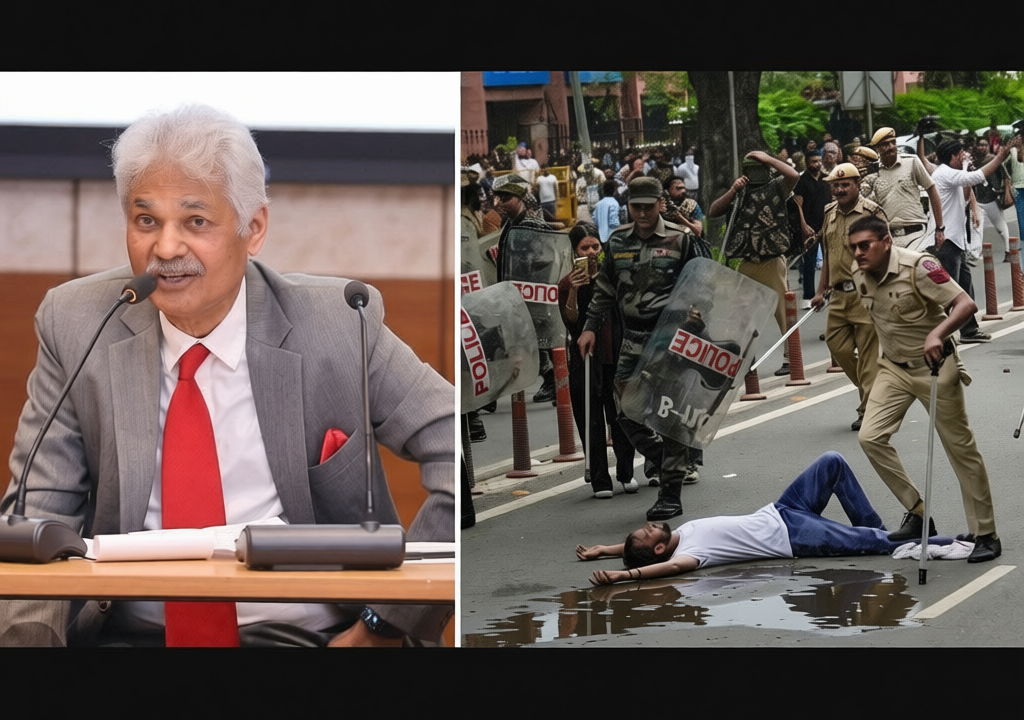
Indiadailyupdate.com – Crowd control is not about inflicting unnecessary harm on demonstrators. This principle guides former IPS officer Yashovardhan Azad’s recent petition to the Supreme Court, seeking a national ban on pellet guns during public protests. The apex court is currently examining allegations of excessive force against students protesting alleged NEET paper leaks. Azad, who served as Special Director of the Intelligence Bureau and later as Information Commissioner, argues that pellet guns have become a symbol of disproportionate response.
Speaking with THE WEEK, Azad expressed deep concern over the sight of young protesters being struck by pellet guns. He stressed that demonstrators are citizens exercising their constitutional right to dissent, not armed threats. For him, the essence of crowd management lies in maintaining order without resorting to physical punishment.
I was deeply pained to see students being hit with pellet guns. These are not terrorists or armed insurgents. They are students exercising their democratic right to protest. Crowd control is not about beating the crowd.
Why Pellet Guns Need Regulation
Azad questions the continued reliance on pellet guns when numerous gentler alternatives exist. Water cannons, lathi charges, chilli spray, tear smoke, and rubber pellets all serve as effective crowd-control tools. He finds it puzzling that authorities choose pellet guns despite the availability of less harmful options.
The imprecision of pellet guns remains a primary concern. Unlike targeted instruments, these weapons release hundreds of small projectiles that scatter unpredictably. Their trajectory cannot be accurately forecasted, meaning they may strike eyes, faces, chests, or other sensitive areas without warning.
There are enough alternatives available. Police have water cannons, lathi charge, chilli spray, tear smoke and rubber pellets. Why should pellet guns be used when less harmful methods exist?
Pellet guns are not aimed at one particular part of the body. Accuracy is the issue. Hundreds of tiny pellets scatter after being fired. No one can predict where they will hit.
The human toll of pellet gun usage has troubled the nation for years. Originally introduced in Jammu and Kashmir as a supposedly non-lethal tool to disperse mobs throwing stones, the weapon gradually became associated with devastating eye injuries, permanent vision loss, and lifelong disabilities among civilians.
Azad contends that this historical precedent should have prevented authorities from employing the same weapon against students on university campuses and urban streets. He noted that pellet guns were deployed in Kashmir under specific security conditions, yet even there they sparked significant public concern. Using them against students, he argued, crosses an unacceptable boundary.
Pellet guns were introduced in Kashmir in a particular security context. Even there, they generated enormous concern. Using them against students is unacceptable.
Looking Toward Democratic Policing
Compounding the issue, according to Azad, is the ongoing training of security personnel in pellet gun operations. The Ministry of Home Affairs continues organizing three-day programmes to educate officers on handling and firing these weapons. While training persists, he raised doubts about whether such weapons deserve continued use when superior alternatives exist.
The training continues, but the larger question is whether we should be using such weapons at all when better alternatives are available.
Rather than expanding pellet gun deployment, Azad advocates for a complete reevaluation of India’s crowd-control framework. His petition requests the Supreme Court to ban pellet guns except in exceptional situations involving immediate threats to human life. He clarified that routine demonstrations, student protests, and public gatherings do not qualify as such emergencies. For Azad, crowd control is not about overwhelming force—it is about measured, proportionate response that respects citizens’ rights while maintaining public order.