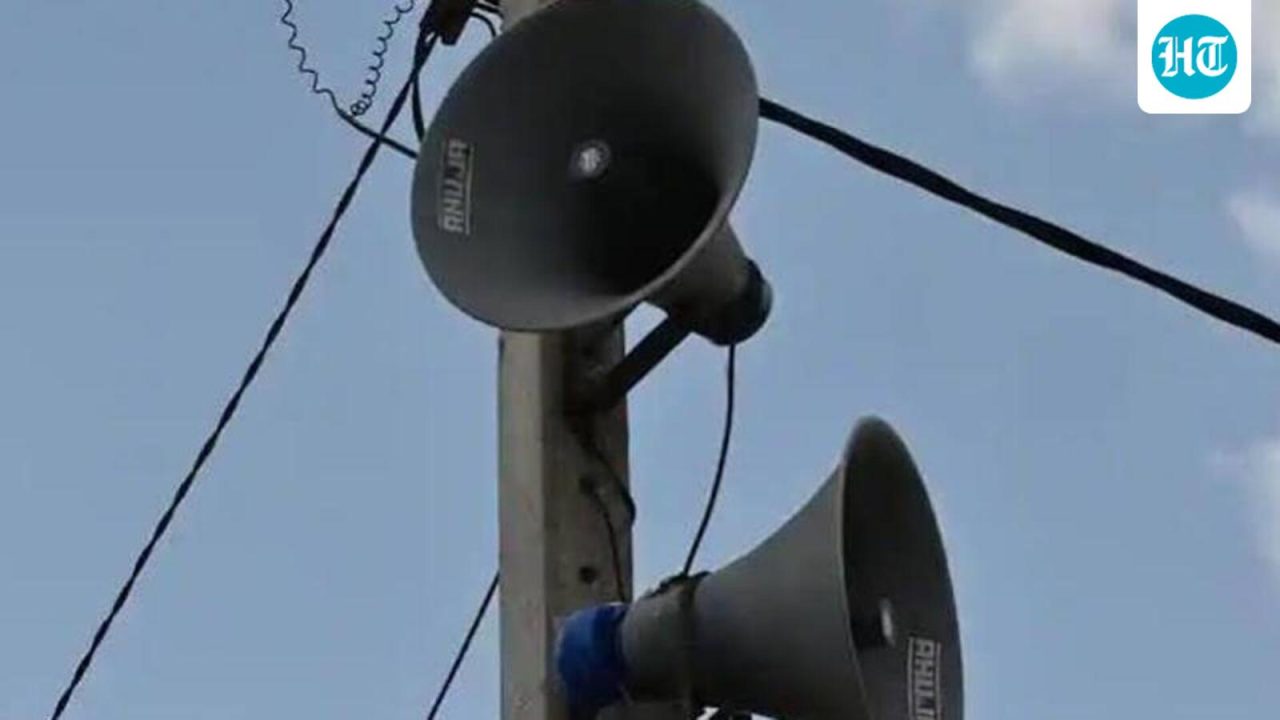

Bijnor police arrest muezzin over alleged loudspeaker violation
Indiadailyupdate.com – Noise should not spill beyond premises, Bijnor police said after arresting a 23-year-old mosque muezzin in Najibabad over allegations that a loudspeaker used during the azaan was operating above permitted limits.
Mohammad Faizan, a resident of Mohalla Maqbara, was arrested on Saturday at Najibuddoula Mosque near Government Inter College in Najibabad. Police said he was produced before a sub-divisional magistrate’s court and sent to judicial custody for 14 days.
The action forms part of a wider enforcement drive involving loudspeakers and sound-amplification equipment at religious sites across Bijnor district.
Police cite sound and permission concerns
According to police, sub-inspector Saurabh Singh and constable Rohit were on patrol near the Government Inter College at around 12:45 pm on Saturday when they heard amplified sound coming from the mosque.
During the inspection, officers found Faizan reciting the azaan, police said. They alleged that the loudspeaker was being used at a volume beyond the prescribed limit, causing sound to travel outside the premises and inconvenience people in the area.
A case was registered at Najibabad police station on the complaint of sub-inspector Saurabh Singh. Police seized the loudspeaker, amplifier and microphone before taking Faizan into custody.
Additional superintendent of police (city) Krishna Gopal Singh said the mosque management did not have permission to use a loudspeaker. He said the principle that noise should not spill beyond premises applies where sound-amplification devices are used.
“The mosque management had no permission to use a loudspeaker. In such a situation, the noise of sound-amplification equipment should not come out of the premises,” Krishna Gopal Singh said.
Part of a district-wide loudspeaker drive
Police said authorities and courts have issued directions on the use of loudspeakers and other amplified sound systems. The Bijnor campaign is intended to ensure compliance with those directions at places of worship and other locations.
In September, Bijnor police said that more than 4,500 loudspeakers had been removed from religious places across the district. The latest case has again focused attention on permissions, volume controls and the responsibility to ensure that noise should not spill beyond premises.
The issue affects religious institutions, commercial establishments, public programmes and other venues that rely on amplification. While religious observances remain important to communities, electronic sound equipment is subject to applicable administrative and legal conditions.
Call for an impartial review
Mohammad Khurshid Mansoori, chairman of Sahaspur Nagar Panchayat, called on the district administration to examine the matter impartially. He also sought information and support regarding legal remedies that may be available to Faizan.
“The azaan is an important part of the religious tradition of the Muslim community. Matters involving religious activities should be handled sensitively, through mutual dialogue and in accordance with the law. An appropriate decision should be taken only after an impartial examination of all the facts,” Mansoori said.
Mansoori suggested discussions involving mosque committees, religious representatives and officials to clarify expectations on azaan practices, loudspeaker operation and compliance with sound-related rules.
Such communication can help committees understand whether permission is required, how amplification equipment may be used and what steps are needed to ensure that noise should not spill beyond premises. Officials, meanwhile, are expected to enforce regulations fairly while recognising the sensitivity of faith-based activities.
FAQ: Loudspeaker rules in Bijnor
What should mosque committees do before using a loudspeaker?
Committees should confirm whether permission is required from the relevant local authority or police administration and ensure that any approved equipment is operated within applicable sound limits.
Can sound from a loudspeaker be heard outside a religious site?
Authorities have stressed that amplified sound should be controlled so it does not travel beyond the premises in violation of applicable rules. Local committees should seek guidance from the competent administration on compliance requirements.
What happens if police find an alleged violation?
Police may inspect the equipment, register a case where they believe rules have been breached and seize sound-amplification devices as part of their action. Any legal outcome is determined through the appropriate judicial process.