The Scale of India’s Education System
Indiadailyupdate.com – OPINION: Can India’s education reforms provide a model for the world? India’s education framework operates on an unprecedented scale, managing the learning of a population surpassing that of numerous countries collectively. With more than 250 million students, nearly 10 million educators, and 1.47 million schools, the nation holds the title of the world’s largest educational ecosystem. As the focus shifts from mere enrollment to cultivating skills for a rapidly evolving world, India’s ongoing reforms highlight a transformative approach to education. This system, spanning across diverse regions and socio-economic backgrounds, has the potential to serve as a global template for sustainable, scalable, and inclusive learning frameworks.
Reimagining Learning for the Future
For years, India’s system prioritized access, ensuring every child had entry to classrooms regardless of geography or background. Yet, the conversation now centers on evolving beyond traditional models, emphasizing comprehension, creativity, and real-world application. The National Education Policy (NEP) 2020 marks this pivotal shift, redefining learning as an inclusive process designed to engage 1.5 billion students within a single framework. This policy challenges the outdated notion that education is solely about rote memorization and introduces a learner-centric approach that aligns with the demands of a modern, interconnected society.
India’s education reforms have also introduced a new structure that replaces the rigid 10+2 system with a 5+3+3+1 model, emphasizing holistic development and early childhood education. This change aims to nurture creativity, critical thinking, and emotional intelligence from a young age, ensuring that students are not only academically proficient but also socially and culturally aware. By integrating interdisciplinary learning and reducing the emphasis on standardized testing, the reforms reflect a broader vision of education that values individual growth over uniformity.
Language and Cultural Inclusion
India’s linguistic diversity plays a central role in its educational identity. Studies show that children absorb information more effectively when taught in their mother tongue. This insight has driven efforts to integrate language-based instruction early in learning, fostering both cognitive development and cultural preservation. The coexistence of thousands of languages in the country exemplifies how diversity can enrich multilingualism and multicultural education. By prioritizing regional languages, India’s reforms aim to create a more equitable learning environment, reducing the barriers that have historically marginalized non-English speakers.
“Research indicates that children will learn better when they tend to receive education in their mother language.”
Moreover, the policy encourages the use of local languages as mediums of instruction, recognizing their role in building confidence and connecting students with their cultural roots. This approach not only enhances academic performance but also promotes a sense of identity and belonging, which are crucial for long-term educational engagement. As a result, India’s education reforms are setting a precedent for nations with similar linguistic challenges, demonstrating how multilingual education can be a catalyst for global educational innovation.
Technology as an Equaliser
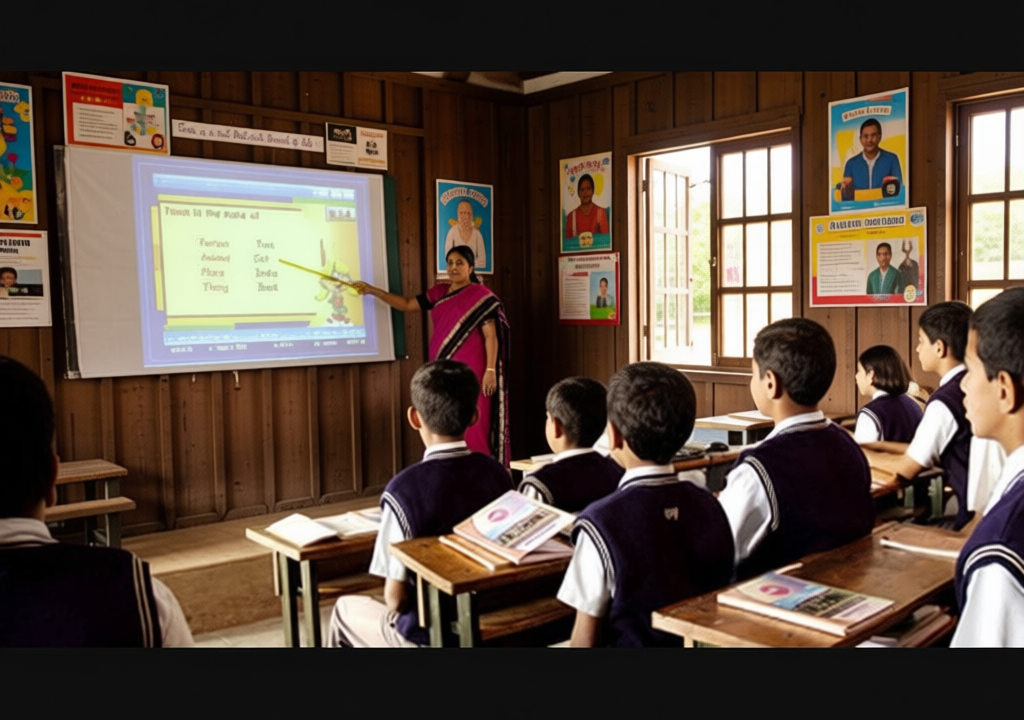
Digital tools and platforms are bridging gaps in access and quality across India’s expansive terrain. Programs like DIKSHA, virtual classrooms, and AI-powered resources have made curriculum-aligned materials available to millions, regardless of regional disparities. While technology cannot fully replace human mentorship, it has expanded equitable opportunities for high-quality learning, empowering educators and students alike. These advancements are particularly transformative in rural areas, where traditional infrastructure is limited, and internet connectivity is improving rapidly.
India’s education reforms also emphasize the integration of digital literacy into the curriculum, preparing students for a tech-driven future. By leveraging technology to personalize learning and provide real-time feedback, the system is becoming more adaptive and responsive to individual needs. This shift not only addresses the immediate challenges of scalability but also sets a foundation for a future where education is no longer confined by physical boundaries.
Employability and Skill Development
India’s reforms underscore the growing link between education and job readiness. As AI and automation redefine industries, students must acquire practical skills to remain competitive. Initiatives like the Skill India mission are fostering partnerships between academic institutions and industries, ensuring graduates are prepared for roles that may not yet exist. This focus on employability is a critical response to the global economic shifts, positioning India as a leader in developing workforce-ready citizens.
By aligning education with market demands, India is addressing the gap between academic learning and real-world application. Vocational training, industry certifications, and internship programs are being integrated into the formal curriculum, giving students hands-on experience. This model not only enhances employability but also reduces the risk of skill obsolescence in an era of rapid technological change. Such a strategy could serve as a blueprint for other nations seeking to balance academic rigor with practical relevance.
Global Relevance of India’s Model
Despite its vastness, India’s system faces continuous challenges, including improving outcomes, reducing inequalities, and adapting to future workforce needs. However, its innovative strategies offer a blueprint for other nations. By blending holistic development with technological integration, India is demonstrating how education can evolve to meet the demands of a globalized, fast-paced world. The focus keyword “OPINION: Can India’s education reforms provide a model for the world?” is increasingly relevant as countries around the globe seek to replicate its success.
India’s model is particularly appealing to developing nations with large populations and limited resources. The emphasis on decentralized governance, teacher training, and curriculum flexibility allows for tailored solutions that can be adapted to local contexts. As a result, the country is not only redefining its own educational landscape but also influencing global education discourse. With its focus on accessibility, adaptability, and inclusivity, India’s education reforms are proving that a system of this scale can still be both innovative and effective.