Women’s Groups Urge Immediate Reservation Implementation
Indiadailyupdate.com – Women’s groups say reservation is a critical step toward gender equality, demanding its immediate implementation to address systemic underrepresentation in Indian politics. A coalition of activists, scholars, and leaders has amassed over 1,516 signatures to support a bold statement from the National Coalition for Women’s Reservation (NCWR), released on July 10. The call emphasizes that women’s reservation in political bodies must not be delayed, as the current system fails to secure equitable participation for women in decision-making roles.
The Women’s Reservation Bill and Its Significance
The Women’s Reservation Bill, introduced in 2023, seeks to reserve 33% of seats in state and Lok Sabha assemblies for women, a policy that has long been advocated by feminist movements. Women’s groups say reservation is essential to dismantle patriarchal structures that have historically marginalized women in public life. This bill, however, remains tied to delimitation and census reforms, which critics argue dilute its impact by spreading focus across multiple agendas.
Proponents of the bill stress that its implementation would create a more inclusive political landscape, enabling women to voice their concerns and shape policies that reflect their needs. Women’s groups say reservation is not just a numerical quota but a transformative measure that could redefine governance in India. Despite its potential, the bill has faced resistance from political parties and policymakers, who often prioritize short-term gains over long-term equity.
Historical Context and Advocacy Efforts
Since the 1974 Phulrenu Ghua Committee report, which highlighted the dismal 5% representation of women in parliamentary seats, the push for reservation has been a consistent demand. Women’s groups say reservation is a right that has been denied for decades, despite its clear benefits for democratic participation. The 2023 bill marks a significant milestone, but advocates insist it must be enforced without delay to ensure meaningful change.
Leaders like Annie Raja from the National Federation of Indian Women argue that the current government has been slow to act, forcing the coalition to take bold steps such as organizing a nationwide dharna. “We cannot tolerate the delay any longer,” Raja stated, underscoring the urgency of the movement. The campaign also draws support from diverse groups, including the Young Women’s Christian Association (YWCA), which highlights the need for grassroots engagement in shaping political reforms.
Protest Plans and Public Mobilization
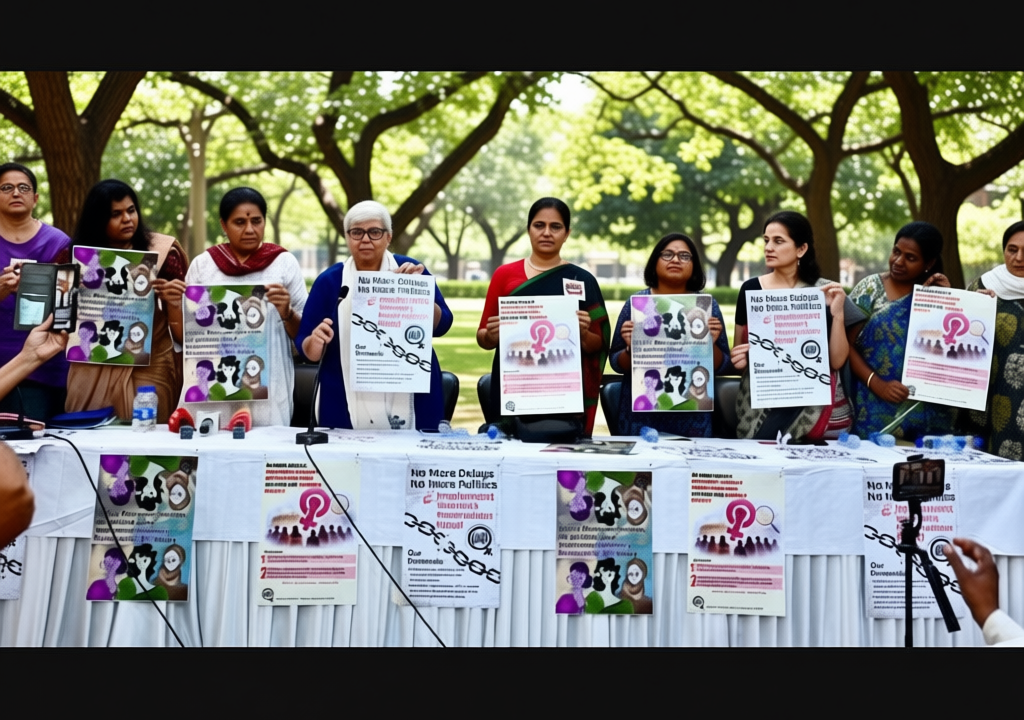
Starting July 20, the NCWR has planned a series of dharnas across India to pressure the government into action. These protests, set against the backdrop of the monsoon session of Parliament, aim to draw attention to the stalled implementation of women’s reservation. Women’s groups say reservation must be prioritized, with participants using music and visual posters to spread awareness creatively.
State-level actions will include demonstrations in Tamil Nadu, West Bengal, and Odisha on July 20–21, while additional events are scheduled in Kerala, Himachal Pradesh, and several other states. The coalition’s strategy reflects a nationwide effort to mobilize public support, with participants from the National Federation of Indian Women and Unity in Compassion stressing that the movement is gaining momentum. “We are Inquilabi Women here,” said a spokesperson, symbolizing the collective strength of the campaign.
Political Resistance and Advocacy Pushback
Despite widespread support, political resistance persists, with critics calling the reservation bill a “smoke-screen” for delay. Transparency advocate Anjali Bhardwaj pointed out that the government has used the bill to divert attention from its core responsibilities, while social activist Shabnam Hashmi labeled the decade a “betrayal of women’s rights.” Women’s groups say reservation must be implemented independently of delimitation and census reforms to ensure its effectiveness.
The coalition insists that immediate action is necessary, as the current legislative process has allowed for prolonged debates and compromises. “They want to respect women but fear putting them in power,” noted Minakshi Singh from Unity in Compassion, capturing the essence of the movement’s frustration. With growing public demand, the protests aim to force a resolution, ensuring that women’s voices are not sidelined in the political arena.
Expected Impact and Long-Term Goals
Women’s groups say reservation will not only increase women’s presence in politics but also enhance the quality of governance by incorporating diverse perspectives. Advocates argue that reserved seats will empower marginalized communities, including Dalits, Adivasis, and women from rural areas, to influence policy decisions. The campaign’s long-term goals include not just legislative change but also a cultural shift toward gender equity in leadership roles.
As the dharnas unfold, the coalition remains hopeful that sustained pressure will lead to tangible results. “We are expecting thousands and thousands of women this time,” said Dhiya Ann Mathew of the YWCA, highlighting the growing public engagement. The movement underscores the importance of collective action, proving that when women’s groups say reservation must be implemented, their voices cannot be ignored. With the July 20 protests, the fight for equitable political representation is entering a new phase of intensity and unity.