Rahul Gandhi Condemns Modi Government’s Removal of Climate Activist Sonam Wangchuk During Hunger Strike
Indiadailyupdate.com – Political leader Rahul Gandhi has accused the Modi government of using excessive force to remove climate activist Sonam Wangchuk from Jantar Mantar during his hunger strike, emphasizing the phrase “No amount of force can deter” to highlight the growing resistance among India’s youth. The incident, which unfolded on Saturday, sparked widespread outrage as Gandhi called out the administration for its aggressive tactics against peaceful protesters. He argued that the Modi government’s actions not only undermine democratic principles but also signal a disregard for the concerns of students and educators.
The Hunger Strike and Its Context
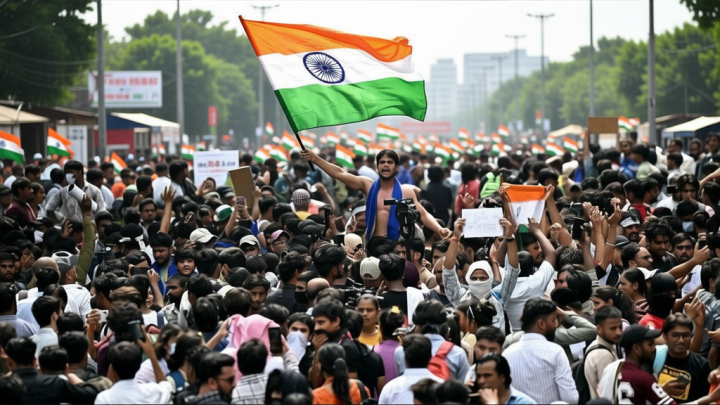
Sonam Wangchuk, a prominent environmental activist known for his work in promoting sustainable development and education in rural areas, embarked on a hunger strike on June 28 to demand accountability for alleged paper leaks and rising educational costs. By Saturday, he had endured 21 days of fasting, a period marked by intense public support and media scrutiny. The protest was initially intended to culminate on July 20, when the Cockroach Janta Party (CJP) planned a march to Parliament to address broader student grievances, including instances of academic dishonesty and the increasing financial burden on education.
Delhi Police intervened on Saturday, taking Wangchuk to Safdarjung Hospital under the direction of the Delhi High Court. Authorities cited medical advice and the need for emergency care as justification, stating that Wangchuk had refused intravenous fluids and oral rehydration solutions despite showing signs of dehydration and metabolic issues. His condition was described as stable, with consistent vital signs, though the move raised questions about the government’s prioritization of health over peaceful dissent.
Political Reactions and Broader Implications
Reacting to the incident, Gandhi used his social media platform to condemn the removal, asserting that the Modi government’s reliance on force to silence protesters reflects a deeper strategy to suppress student voices. “No amount of force can deter the resolve of India’s students,” he tweeted, framing the event as a symbol of the administration’s struggle to maintain control over public discourse. This statement resonated with critics who viewed the hunger strike as a pivotal moment in the ongoing debate about educational reforms and government transparency.
The CJP, which organized the protest, described the removal as a national shame, sharing a video that showed Wangchuk being wrapped in white sheets and taken away by police. The party’s founder, Abhijit Dipke, alleged that protesters faced a coordinated crackdown, with some individuals being beaten and detained. “No amount of force can deter the courage of our youth,” Dipke added, underscoring the movement’s commitment to non-violence while challenging the government’s handling of the situation.
The incident has reignited discussions about the role of the Delhi High Court in mediating between protesters and authorities. While the court’s order was cited as a legal basis for Wangchuk’s removal, critics argue that it was used to justify an abrupt and forceful action against a long-standing advocate for educational and environmental causes. This has sparked debates on whether the judiciary is being manipulated to support the government’s agenda, or if it is genuinely serving as a mediator in a tense standoff.
Student Concerns and Educational Reforms
Wangchuk’s hunger strike has drawn attention to critical issues facing India’s education system, including widespread paper leaks, the rising cost of tuition, and the alarming rate of student suicides. These concerns have been amplified by the Modi government’s focus on centralizing educational authority and implementing policies that critics claim prioritize economic growth over student welfare. Gandhi, in his public critique, highlighted the interconnectedness of these problems, suggesting that the government’s response to Wangchuk’s protest reveals a pattern of ignoring grassroots movements in favor of top-down decisions.
Meanwhile, the CJP has positioned Wangchuk’s removal as a turning point in the fight for educational equity. The party’s leaders argue that the event underscores the urgency of addressing systemic failures in the curriculum and exam systems, which they say have eroded student trust and morale. With the hunger strike nearing its 22nd day, the movement continues to gain momentum, drawing comparisons to historical protests that have shaped India’s democratic landscape. Supporters of Wangchuk are calling for solidarity, urging the public to recognize the importance of non-violent resistance in safeguarding the rights of students and educators.
The debate over Wangchuk’s removal has also sparked a broader conversation about the Modi government’s approach to dissent. While the administration defends its actions as necessary to maintain order and ensure public safety, opponents see it as a calculated effort to undermine the credibility of student-led initiatives. With the focus keyword “No amount of force can deter” echoing through the discourse, the incident remains a focal point for those advocating for a more inclusive and responsive governance model in India.