Blood on the Ballot: The Voices of Pakistan-Occupied Kashmir
Indiadailyupdate.com – On June 5, 2026, Pakistan declared its intention to hold elections for the Legislative Assembly in the region it administers, Pakistan-occupied Kashmir (PoK), scheduled for July 27. This move was intended to highlight the country’s democratic image globally. Yet, the announcement was accompanied by the designation of the Joint Awami Action Committee (JAAC), a key civil society group in PoK, as a proscribed terrorist organization under the Anti-Terrorism Act of 2014. The same evening, security forces opened fire on a trader during a confrontation, killing him.
The JAAC has long been a vocal advocate for the people of PoK, pushing for essential reforms such as affordable electricity, accessible rations, and improved healthcare. Its platform also emphasizes better governance, relief from inflation, and greater political representation. The group has consistently criticized the exploitation of the region’s natural resources and the systematic exclusion of local voices from decision-making processes. Earlier in June, the JAAC had planned a region-wide demonstration, known as a Chakka-Jam, on June 9 to protest state violence and neglect. The timing of the ban, issued before the protest and the elections, appears designed to suppress dissent and prevent organized opposition.
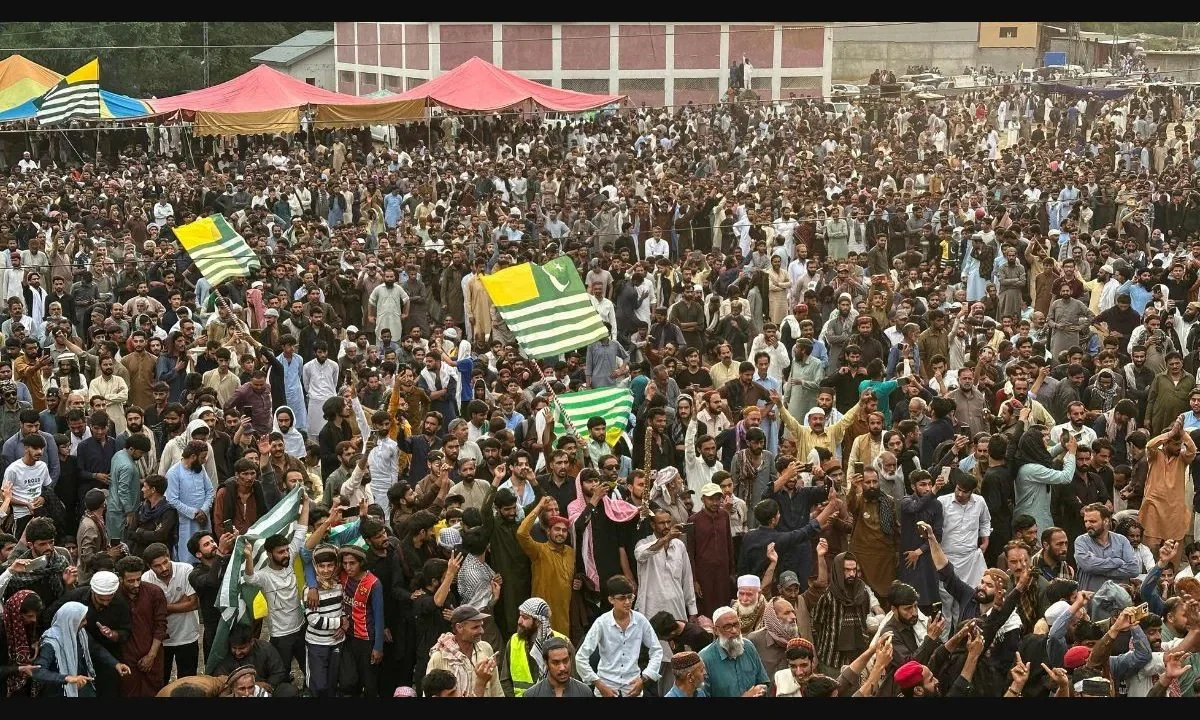
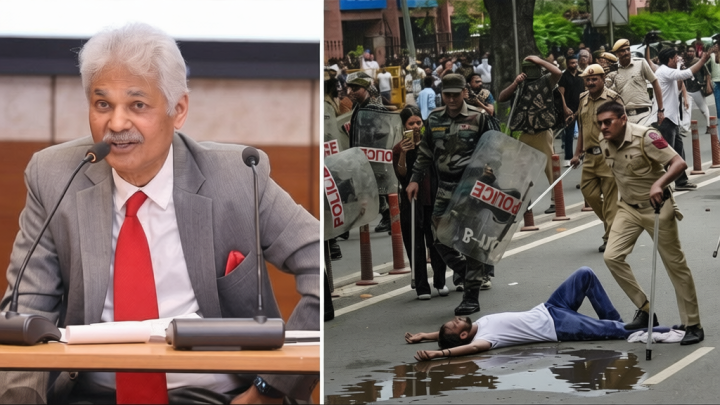
Despite the ban, protests persisted, with civilians demanding political reforms and an end to the suppression of legitimate grievances. Officials accused demonstrators of attacking a military hospital in Rawalakot, prompting a violent response that left more than a hundred dead and hundreds injured. Over a thousand people were detained in the process. Communication networks were disrupted, and supply lines were cut across the region, with Rawalakot becoming the focal point of the unrest. Road blockades and frequent clashes between protesters and security forces intensified the situation.
Structural Injustice and Political Control
The JAAC’s campaign has also targeted the composition of PoK’s legislative assembly, which consists of 53 members. Of these, 12 seats are reserved for refugees who fled Jammu & Kashmir in 1947 and 1965, now living in Pakistan. Six seats represent refugees from Jammu, whose population is around 434,000, while six seats are allocated to those from the Kashmir Valley, numbering approximately 30,000. The JAAC argues this structure is inherently unfair, as it gives disproportionate influence to refugees, often enabling the ruling party in Islamabad to secure compliant governments in Muzaffarabad.
“The setup clearly favors refugee communities, using them as a tool to entrench political control,” the group stated.
India has formally challenged Pakistan’s claim over PoK, asserting that the territory remains legally part of India. The country’s position, rooted in international law, is valid but increasingly strained by the scale of the current crisis. In the Indian constitutional framework and the moral context of the Kashmir dispute, the people of PoK are regarded as residents of Indian territory. Their struggle for basic needs—such as affordable flour and electricity—has been met with lethal force from an occupying state. India’s response to this violence has been swift, yet the situation continues to escalate, underscoring the gap between legal arguments and on-the-ground realities.