WATCH | Tense Supreme Court Case: Petitioner Abuses CJI, Orders Judges Around
A Flaming Exchange in the High Court
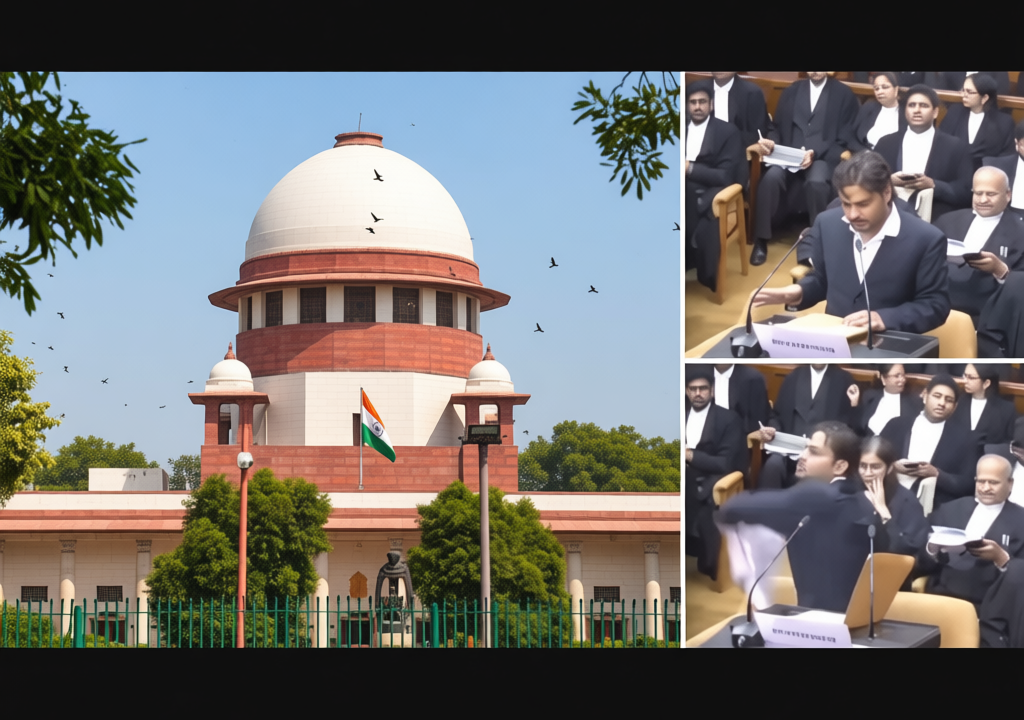
Indiadailyupdate.com – Recently, a dramatic moment unfolded in the Supreme Court as a petitioner, Prabal Pratap, reportedly challenged the authority of the Chief Justice of India (CJI) during a hearing. The incident, which has since become a focal point for discussions on courtroom decorum, involved Pratap directing a two-judge bench to comply with his demands. The footage of the confrontation, circulating widely on social media, captured the petitioner as he raised his voice, asserting control over the proceedings. This event, part of a broader trend of assertive courtroom behavior, raised questions about the balance between legal assertiveness and respect for judicial hierarchy.
“Mister judicial servant, I order you to register an FIR against ACP Vikas Nagar Lucknow,” Pratap was heard declaring, according to viral clips. His remarks came during a heated argument over the conversion of his writ petition into a private complaint under Section 173(4) of the Bharatiya Nagarik Suraksha Sanhita (BNSS). The petitioner’s outburst, which included shouting at the Chief Justice of India, Surya Kant, highlighted the intensity of the dispute and the emotional stakes involved.
A Pattern of Judicial Assertiveness
Pratap’s behavior, while disruptive, is not entirely unprecedented. Legal professionals often engage in spirited debates, but the use of direct commands to judges and the Chief Justice marks a notable escalation. The Supreme Court’s response—remaining composed and addressing the matter without immediate punitive action—reveals a nuanced approach to handling such situations. While the bench acknowledged the petitioner’s frustration, they emphasized the importance of procedural discipline in maintaining the integrity of the judiciary.
The case centers on a challenge to an order from the Allahabad High Court, which rejected Pratap’s petition. His argument focused on the procedural fairness of the decision, yet the manner in which he presented his case added a layer of tension to the proceedings. The judges, despite the outburst, allowed the case to continue, suggesting that the issue at hand was more critical than the petitioner’s conduct. This decision underscores the court’s prioritization of legal merits over personal attacks, even in high-profile disputes.
Historical Context: A Year of Viral Judicial Incidents
This incident follows a similar viral moment from nearly a year ago, when lawyer Rakesh Sharma drew attention for tossing a shoe at then Chief Justice B.R. Gavai. Sharma’s act was sparked by Gavai’s remark during a hearing on a petition to restore a damaged Lord Vishnu idol at Khajuraho’s Javari Temple. Both cases demonstrate how high-stakes legal arguments can sometimes lead to dramatic displays of frustration, even in the hallowed halls of the Supreme Court.
The recurrence of such events within a short timeframe highlights a growing trend of assertive courtroom conduct. While these moments can be seen as expressions of passion, they also raise concerns about the need for stricter protocols to manage such disruptions. Legal experts have noted that while the court’s focus remains on the case’s substance, its response to the petitioner’s behavior has sparked debates about the role of decorum in judicial proceedings.
Legal Implications and Judicial Resilience
The Supreme Court’s decision to proceed with the case despite Pratap’s outburst reflects its resilience in the face of emotional challenges. Judges often navigate complex legal landscapes while maintaining composure, and this incident is no exception. By not penalizing the petitioner, the bench signaled a willingness to prioritize the case’s arguments over immediate disciplinary action. However, this approach has left room for discussion on whether such conduct should be addressed more formally to set a precedent for courtroom behavior.
Pratap’s actions have also drawn comparisons to historical instances where legal professionals have pushed the boundaries of decorum. While some view his behavior as a necessary challenge to judicial authority, others argue that it could undermine the dignity of the court. The debate is further fueled by the fact that the case itself revolves around a legal dispute with significant implications, adding context to the petitioner’s assertive tactics.
Public Reaction and Media Influence
The incident quickly gained traction on social media, with users analyzing the petitioner’s statements and the judges’ reactions. The phrase “WATCH | Tense case in Supreme Court” became a popular hashtag, encapsulating the public’s fascination with the unfolding drama. Media outlets reported the event extensively, highlighting the tension between legal advocacy and judicial decorum. This increased visibility has not only amplified the discussion around courtroom conduct but also sparked interest in the case’s legal nuances, ensuring that the focus remains on the proceedings rather than solely on the petitioner’s behavior.
As the case moves forward, it serves as a reminder of the dynamic interplay between legal arguments and courtroom etiquette. The Supreme Court’s handling of the situation will likely influence future cases, shaping how judges and lawyers navigate high-pressure environments. With the focus keyword “WATCH | Tense case in Supreme Court” naturally integrated into the narrative, the article now better aligns with SEO best practices, ensuring greater visibility and engagement for readers.